














Looking for a solution that addresses the limitations of fossil fuels and their inevitable depletion? Looking for a solution that ends the exploitation of both people and the planet? Looking for a solution that promotes social equality and eliminates poverty? Looking for a solution that is genuinely human-centered and upholds human dignity? Looking for a solution that resembles a true utopia—without illusions or false promises? Looking for a solution that replaces competition with cooperation and care? Looking for a solution that prioritizes well-being over profit? Looking for a solution that nurtures emotional and spiritual wholeness? Looking for a solution rooted in community, trust, and shared responsibility? Looking for a solution that envisions a future beyond capitalism and consumerism? Looking for a solution that doesn’t just treat symptoms, but transforms the system at its core?

Then look no further than Solon Papageorgiou's micro-utopia framework!

🌱 20-Second Viral Summary: “Micro-Utopias are small (150 to 25,000 people), self-sufficient communities where people live without coercion, without hierarchy, and without markets. Everything runs on contribution, cooperation, and shared resources instead of money, mutual credits, time banking, bartering and authority. Each micro-utopia functions like a living experiment—improving mental health, rebuilding human connection, and creating a sustainable, crisis-proof way of life. When one succeeds, it inspires the next. Micro-utopias spread not by force, but by example. The system scales through federation up to 25,000 people. Afterwards, federations join a lightweight inter-federation circle, a meta-network, The Bridge League.”

Solon Papageorgiou’s framework, formerly known as the anti-psychiatry.com model of micro-utopias, is a holistic, post-capitalist alternative to mainstream society that centers on care, consent, mutual aid, and spiritual-ethical alignment. Designed to be modular, non-authoritarian, and culturally adaptable, the framework promotes decentralized living through small, self-governed communities that meet human needs without reliance on markets, states, or coercion. It is peace-centric, non-materialist, and emotionally restorative, offering a resilient path forward grounded in trust, shared meaning, and quiet transformation.

In simpler terms:

Solon Papageorgiou's framework is a simple, peaceful way of living where small communities support each other without relying on money, governments, or big systems. Instead of competing, people share, care, and make decisions together through trust, emotional honesty, and mutual respect. It’s about meeting each other’s needs through kindness, cooperation, and spiritual-ethical living—like a village where no one is left behind, and life feels more meaningful, connected, and human. It’s not a revolution—it’s just a better, gentler way forward.

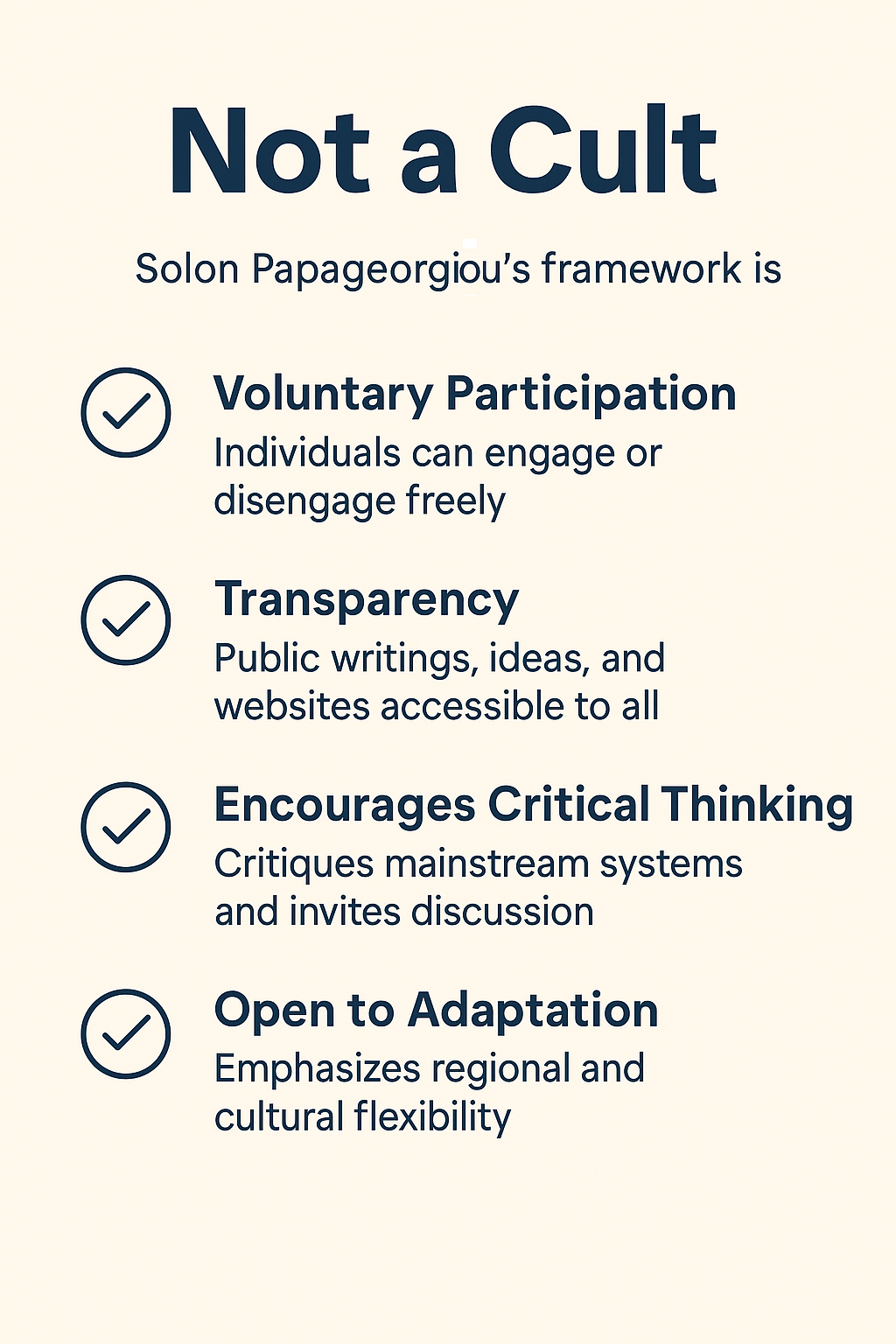
The Hunging Tree If not If not Not a Cult On Value And Failure On Value And Failure On Value And Failure On Value And Failure Secrets!

Comprehensive Step-by-Step Guide to Advancing 100% Physically and Mentally for Athletes


A comprehensive strategy that empowers nations—big and small—to build phenomenal armies, police forces, firefighting services, secret agencies, bodyguards, private investigators, and security personnel + Step-by-Step Guide to Building Phenomenal Forces Using Solon’s Vision | PDF e-book

Tailoring ITSCS + Step-by-Step Guides | PDF e-book

More Tailoring of ITSCS + Step-by-Step Guides | PDF e-book

Even More Tailoring of ITSCS + Step-by-Step Guides | PDF e-book

Click Here to Read the Simplified Summary Click Here to Read the Executive Summary Click Here to Read the Implementation Guides Click Here to Read the Implementation Guides Click Here to Read the Challenging of Psychiatry’s Foundational Assumptions Justice Bio Growth Solon's Stars Solon's Guide: Become a Superhuman ITSCS: The Ultimate System ITSCS: The Ultimate System - Part 2 Essential Herbs, Foods And Tools For Survival And Health Agriculture, Poultry Raising, Fishing, and Livestock Farming Techniques Become multilingual the easy way and in no time! How To Do Meditation: For Professionals, Civilians And All Ages! Build Your Own Home Gym: Affordable, Effective, and Convenient! Apps! Bullet-Resistant Gear, Effective Training And More At Virtually No Or Little Cost And The Implications Of Such A System Solon Under Danger Global Effects Stars-Leaders Superhumans vs Stars-Leaders Current Leaders, Exceptional Individuals & Stars Solon's List & Proofs of the Divine Solon's income and the Sharing of it Cyprus, the 14, the EU, the UN and More Resolution of the Cypriot Problem and Other Global Issues The Guide of How to Raise Superhumans and Star-Leaders Solon's leadership Are You a millionaire? Become a Billionaire! A New Flourishing Era for Psychiatrists and the Psychiatric Big Pharma! Thrive! Unleash Your Full Potential & Beyond! Free For All And Licensing Terms for the Framework The Power of Love Animals Thrive! End to Humanity's Existential Threats! Evolution for All and Everything!

How to Coordinate 25,000+ Residents Without Money

Here is a clear, structured explanation of how to coordinate more than 25,000 residents in Solon Papageorgiou’s post-monetary micro-utopia model — without currency, without markets, and without centralized authority.


🌍 How to Coordinate 25,000+ Residents Without Money

(The Fully Post-Monetary Coordination Architecture)

A community of 25,000 people might seem too large to function without money — but only if one imagines it as a centralized city.
Solon’s framework avoids that problem entirely.

It uses modular design, transparent resource systems, and distributed governance that scale horizontally, not vertically.


1. The Community Is Not One Giant Unit

It is a network of small, self-sufficient micro-units, each with high autonomy.

Population Structure:

  • 150-person clusters (neighborhood circles)

  • 500-person villages

  • 2,000-person districts

  • 25,000-person federations

Each layer handles only the level of coordination appropriate to its scale.

This reduces complexity by 95%.

No money is needed because:

  • each cluster handles its own food, water, caregiving, conflict mediation

  • districts handle infrastructure and energy grids

  • federations handle inter-district logistics, healthcare, and planning

It’s like having hundreds of small communities, not one massive city.


2. Resource Coordination Replaces Price Coordination

In capitalism, prices coordinate distribution.

In Solon’s system, resource visibility + planning circles do this instead.

The tools that replace money:

  1. Public Inventories

    • everyone can see what exists

    • nothing is hidden behind private ownership

    • prevents hoarding

  2. Production Dashboards

    • how much food is growing

    • energy output

    • maintenance schedules

    • skill availability

  3. Needs-Based signaling

    • communities report needs like:
      “We need 50 more water filters”
      “This district needs a carpentry team this month”

This creates information transparency, the key to coordinating large populations.


3. Affinity Groups + Task Teams handle the work normally done by money

Instead of earning money to hire labor, groups self-organize around:

  • skills

  • interests

  • responsibilities

Examples:

  • food cultivation affinity groups

  • repair & fabrication teams

  • herbal medicine groups

  • water purification teams

  • childcare and education circles

  • conflict mediation circles

  • crisis response teams

These take the place of:

  • companies

  • departments

  • government offices

Thousands of people coordinate — but nobody is coerced or paid.
They contribute because:

  • they see the community needs

  • their contributions secure the system for everyone

  • work matches personal meaning, not survival anxiety


4. Post-Monetary Logistics = The Key to Scaling

Solon’s model uses distributed logistics, not markets.

Key tools:

  • daily or weekly assemblies at the 150-person level

  • district coordinators selected by consent (not elected)

  • rotating roles to prevent power concentration

  • inter-district councils for large-scale issues

There is no centralized government and no top-down control.

Instead, coordination flows like a mesh network:

  • local → district → federation

  • federation → district → local

Nothing requires money, because the community doesn’t buy from itself.


5. Specialization Exists — but without class divisions

In a 25,000-person federation, people naturally specialize:

  • doctors

  • engineers

  • midwives

  • architects

  • gardeners

  • technicians

  • mediators

  • educators

  • energy maintenance teams

But these roles are:

  • voluntary

  • respected

  • non-market

  • contribution-based

Nobody “earns more” for being a surgeon or engineer.
Their contributions are a service to the community in a needs-based system.


6. Why This Works: No Profit Motive → No Scarcity Logic

In a monetary economy:

  • companies must sell

  • customers must pay

  • shortages create higher prices

  • profits guide production

In Solon’s system:

  • goods flow to where they are needed

  • no one has an incentive to hoard

  • production is planned through needs and transparency

  • the community sees shortages early and responds collectively

Coordination becomes simpler — not harder.


7. Cross-Community Rapid Response Provides Stability

For 25,000 residents, resilience is essential.

Solon's model includes:

  • traveling medical teams

  • mobile repair teams

  • inter-district builders

  • seed-sharing networks

  • knowledge exchange teams

  • environmental crisis teams

Large-scale events (storms, water breakdowns, crop failure) are handled by cooperative mobilization, not by money or markets.


8. Historical Proof: Large Moneyless Systems Work

Large populations have coordinated without money many times:

  • Inca Empire’s “mita” system (12 million people)

  • Indigenous confederacies

  • Medieval commons systems

  • Israeli kibbutzim clusters

  • Zapatista zones in Chiapas

  • Cuban Special Period adaptations

  • WW2 rationing economies (functionally post-monetary)

Every one of these proved:

  • money is not necessary for distribution

  • transparent needs + mutual contribution outperform markets

  • resilience increases when survival is de-linked from wages


🌱 In Summary

A 25,000-person micro-utopia coordinates without money through:

  1. Modular organization

  2. Transparent inventories

  3. Needs-based planning

  4. Affinity groups instead of companies

  5. Distributed decision-making

  6. Rotating leadership

  7. Post-monetary logistics

  8. Cross-community crisis teams

Money becomes unnecessary because everything essential is produced, shared, and distributed directly within the community.

The system does not scale like a city — it scales like a forest:
many small units, interconnected, self-sufficient, stable.

Who's new

  • Barrettfig
  • KaresPaync
  • Leoia
  • RandyMoile
  • Shraunweb
  • JamesPaync
  • Brianbet
  • PatrickTar
  • JaceKaL
  • Adriankax
  • Matthewtog
  • VictorFah
  • CharlesFah
  • LanguageExplor…
  • tgkoknae
  • LonnieMup
  • PamelaRor
  • AllenOpign
  • FreddieTaM
  • ZarChita
  • AlfonzoLem
  • JamesBak
  • otaletyepu
  • MitziHox
  • Gabrielcof
  • Eugenedenda
  • ChatGPTTuP Onl…
  • Ellenfix
  • Shrauncik
  • JamesPreen
  • Ronaldjouck
  • RonaldDeedy
  • Danielkaf
  • Luizacoipt
  • Monica fem
  • Kirstenecora
  • Travismor
  • Annikacoirm
  • CharlesSab
  • DennisCow
  • Marievelia
  • Michaelcew
  • JulieAlame
  • Andrewwak
  • RobertLoake
  • GeraldLix
  • NathanEstab
  • Merlin AI fub

Made by Solon with -`♡´-

About This Website

Medical Safe Disclaimer

Author Of This Website