







Solon Papageorgiou’s framework of micro-utopias—outlined in the model found at anti-psychiatry.com
—is borderless, non-state, and non-nationalistic due to the following core philosophical, ethical, and practical principles:
1. Ethical Rejection of Coercion and Hierarchy
Borderlessness reflects a deep commitment to freedom of movement and association. Borders are seen as artificial constructs tied to coercive systems of control, exclusion, and conflict.
Non-state orientation stems from the rejection of centralized authority and coercive enforcement (e.g., military, police, psychiatry), which Papageorgiou views as incompatible with genuine well-being, autonomy, and dignity.
Non-nationalism arises from a humanist and global perspective that prioritizes shared humanity over arbitrary divisions such as nationality, ethnicity, or race.
2. Response to Historical and Structural Violence
Nationalism and state systems have historically enabled:
Colonialism
Genocide
War and militarism
Surveillance and psychiatric abuse
The framework is built to never reproduce these patterns. It tries to "start over" with voluntary, peaceful, and just communities at a small scale.
3. Spiritual and Philosophical Universality
Papageorgiou’s framework draws on elements of world religions and philosophical traditions, emphasizing inner freedom, nonviolence, and universal ethics.
Nationalist ideologies often exclude or suppress spiritual diversity; micro-utopias aim to embrace universal values that transcend borders and dogmas.
4. Practicality for a Post-Crisis World
In a world increasingly affected by:
Climate collapse
Refugee crises
Authoritarianism
Economic instability
the micro-utopia model positions itself as resilient, portable, and adaptable.
Statelessness and borderlessness enable replication across regions without dependence on failing or oppressive states.
5. Individual-Centric Community Design
The focus is on the well-being, agency, and spiritual growth of individuals, not on serving abstract entities like “the nation” or “the economy.”
People can opt in or out freely. No one is forced into obedience to a nation or state system.
6. Rejection of Psychiatry as State Tool
The anti-psychiatry emphasis is not just clinical—it critiques psychiatry’s role in enforcing state norms.
Micro-utopias reject pathologizing dissent or medicalizing suffering under nationalist, capitalist, or statist assumptions.
In Summary:
Solon Papageorgiou’s framework is borderless, non-state, and non-nationalistic because it:
Rejects coercion and control in all forms.
Aims to heal global trauma, not perpetuate systems that caused it.
Builds on a spiritually informed, universalist, voluntary ethos.
Seeks to offer a practical alternative to both failed liberal democracies and oppressive regimes.
Solon Papageorgiou’s framework of micro-utopias is anti-capitalistic, post-capitalistic, anti-corporation, and anti-business in the usual form for profound ethical, social, psychological, and spiritual reasons. These stances are not just economic—they reflect a radical rethinking of human relationships, value, work, and power.
1. Capitalism Is Seen as Intrinsically Coercive and Dehumanizing
Profit over people: Capitalism prioritizes profit, competition, and accumulation over human dignity, care, and community.
Commodification of life: Everything becomes a product—health, education, housing, even emotions.
Inequality and exploitation: Wealth concentrates, while billions suffer from poverty, insecurity, or meaninglessness.
➡ Papageorgiou rejects this structure in favor of mutual aid, gift economies, and non-monetary value systems.
2. Post-Capitalism as a Spiritual and Psychological Liberation
The framework aims at inner and outer freedom, which capitalism obstructs through:
Consumerism and addiction
Wage slavery and burnout
Psychological manipulation through advertising
Post-capitalism here means creating societies that do not require money or markets as their organizing principle.
3. Anti-Corporation Stance: Corporations as Engines of Harm
Corporations are described as:
Legally shielded entities with no conscience
Drivers of ecocide, war, and worker exploitation
Promoters of psychological control through mass media, surveillance, and pharmaceuticals
Papageorgiou sees them as non-human artificial power centers, antithetical to micro-utopias rooted in human scale and ethics.
4. Anti-Business (in the Usual Form): Work Without Coercion or Domination
In usual capitalist business:
There are bosses and subordinates
People sell their time and freedom under threat of poverty
Innovation and creativity are hijacked for profit
The framework replaces this with cooperative, creative, voluntary work, often done collectively or autonomously.
5. Mental Health and Economic Systems Are Linked
The framework is deeply anti-psychiatric, and views capitalism as one of the root causes of distress:
Anxiety, depression, ADHD, burnout—often responses to capitalist alienation.
Psychiatry, under capitalism, becomes a tool to drug or “fix” people to fit into harmful systems.
➡ A new economic form must allow people to be well without conformity or medication.
6. Degrowth, Simplicity, and Sufficiency
The framework favors:
Local production
Self-sufficiency
Voluntary simplicity
It rejects the capitalist illusion of endless growth, which is ecologically suicidal.
7. Building a System of Care, Not Exchange
Papageorgiou’s micro-utopias are built on:
Gift economies
Communal support
Unconditional access to essentials: housing, food, education, healing
These replace capitalism’s obsession with “value extraction” and transactional relationships.
In Summary:
Solon Papageorgiou’s framework is:
| Position | Reason |
|---|---|
| Anti-capitalistic | Capitalism is exploitative, coercive, and spiritually hollow. |
| Post-capitalistic | It builds alternative economies rooted in care, simplicity, and voluntary cooperation. |
| Anti-corporation | Corporations are seen as soulless engines of ecological and psychological harm. |
| Anti-business (usual form) | Traditional business hierarchies and wage labor violate the model’s ethics of freedom, equality, and dignity. |
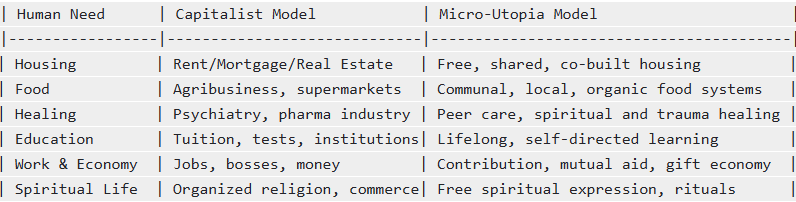
Here’s how a micro-utopia under Solon Papageorgiou’s framework could operate practically without capitalism, corporations, or conventional business, while still providing for people's needs—housing, food, healing, education, and community life:
🏠 1. Housing Without Capitalism
✅ Principle: Shelter is a birthright, not a commodity.
🔧 How it works:
Community-built housing: Residents co-create homes using natural or recycled materials (e.g., earthbag, cob, bamboo, etc.).
No rent, mortgages, or ownership: Homes are not for sale or profit. They’re shared, passed on, or reallocated as needed.
Design for sufficiency, not luxury: Emphasis is on low-energy, resilient, dignified dwellings, not excess.
Flexibility & transience: People can move between micro-utopias without “selling” anything.
🌾 2. Food Without Markets or Agribusiness
✅ Principle: Food is sacred, shared, and ecological.
🔧 How it works:
Permaculture, agroecology, food forests: Small-scale, sustainable systems that mimic nature.
Shared labor, not wages: Everyone contributes as they can; food is freely available to all.
Seed-saving and no GMOs: Complete rejection of corporate control of agriculture.
Local & seasonal: No industrial transport or packaging chains. Community meals are normal.
🩺 3. Healing Without Psychiatry or Profit
✅ Principle: Healing is relational, not institutional.
🔧 How it works:
No psychiatric drugs, coercion, or diagnoses: Distress is understood as a response to trauma or oppression, not a medical disorder.
Peer support, listening spaces, spiritual and holistic healing: Community members support one another with compassion, presence, and mutual respect.
Healing is voluntary and inclusive: No experts above others; the wisdom of the group is honored.
Traditional and plant-based medicine may be used with consent and reverence—not as a business.
📚 4. Education Without Schools, Fees, or Standardization
✅ Principle: Learning is natural, lifelong, and communal.
🔧 How it works:
Self-directed education: Children and adults choose what and how they learn.
Mentorship, storytelling, real-life skills: Instead of standardized testing, learning is embedded in daily life.
No tuition or credentials: Knowledge is shared freely; no institutions profit from it.
Cross-age and multi-lingual environments: Learning is woven into play, work, and spiritual practice.
🤝 5. Economy Without Money, Business, or Jobs
✅ Principle: Contribution replaces transaction.
🔧 How it works:
Gift economy: Skills, labor, and resources are shared without accounting or expectation.
Needs-based distribution: Everyone is cared for according to their needs, not their output.
Time-sharing or circles of mutual support: These replace formal employment.
Small-scale tools and crafts: People make what they need or trade directly—no branding, marketing, or profit margins.
🧘 6. Community & Spiritual Life
✅ Principle: Belonging and transcendence over consumption.
🔧 How it works:
Communal rituals, storytelling, art, music: These take the place of entertainment industries.
Spirituality is diverse and free-form: No dogma, no church hierarchies. Practice is shared but voluntary.
Conflict resolution through council and consensus, not policing or court systems.
🔄 7. Replication and Portability
Micro-utopias can be replicated anywhere, even informally or temporarily.
They're not dependent on national economies, funding agencies, or corporate sponsorships.
They spread through inspiration, invitation, and solidarity, not franchising or scale-focused expansion.
🌱 Summary Diagram (text format):
Solon Papageorgiou’s framework of micro-utopias is profoundly anti-psychiatry because it sees psychiatry as one of the central pillars of coercion, alienation, and systemic violence in modern society—alongside capitalism, statism, nationalism, and militarism. This anti-psychiatric stance is foundational to the entire model and permeates its ethics, structure, and goals.
🧠 1. Psychiatry as a Tool of Social Control, Not Healing
Psychiatry is seen not as a branch of medicine, but as a disciplinary apparatus that:
Labels nonconformity as “illness”
Silences dissent through diagnostic categories
Enforces compliance to oppressive social norms
✅ In Papageorgiou’s model, distress is political, existential, or spiritual—not pathological.
🚫 2. Rejection of Coercion: No Involuntary “Care”
Psychiatry relies on involuntary hospitalization, forced medication, and legal disempowerment (e.g., guardianship, involuntary commitment).
The framework holds that no one should be “treated” against their will under any circumstance.
✅ In micro-utopias, healing is always voluntary, relational, and non-hierarchical.
💊 3. Opposition to Psychiatric Drugs as Chemical Control
Psychiatric medications are seen as chemical restraints rather than genuine treatments.
Many cause dependence, cognitive dulling, emotional suppression, or long-term harm.
They serve the function of making people more manageable for families, institutions, and employers.
✅ The model promotes non-drug alternatives: rest, dialogue, connection, nature, and spiritual growth.
🧾 4. Psychiatry Has No Proven Biological Basis
Solon’s framework, supported by decades of critical research, holds that:
No mental illness has been biologically proven (e.g., no biomarkers, no objective tests).
Psychiatry medicalizes suffering without scientific legitimacy.
✅ The framework is grounded in philosophy, ethics, and sociology, not pseudo-medical authority.
⚖️ 5. Survivors of Psychiatry as a Foundational Voice
The model explicitly honors the voices of psychiatric survivors—those harmed or silenced by the system.
Their lived experience is considered more valid than the opinions of professionals who upheld the system.
✅ Micro-utopias are built as safe havens for those who have been pathologized, criminalized, or abused.
💼 6. Psychiatry and Capitalism Are Interlinked
Psychiatry keeps the labor force “functional”, by drugging or sidelining those who resist capitalist values (e.g., productivity, conformity).
It pathologizes poverty, grief, burnout, trauma, and political anger.
✅ In rejecting capitalism, the framework must also reject the psychiatric system that props it up.
🏥 7. Psychiatry as a Modern Theocracy
Psychiatry behaves like a secular religion, declaring who is “sane” and who is not—with no objective evidence.
It punishes spiritual experiences, altered states, deep sorrow, or ecstatic insight as “disorders.”
✅ Papageorgiou’s framework encourages spiritual openness, existential questioning, and multiple worldviews—not reductionism.
🧘 8. Alternative Healing Without Diagnosis
Healing in micro-utopias is based on:
Listening, presence, mutual care
Community support, artistic expression, and meaning-making
Restoration of autonomy and agency
✅ No DSM, no ICD, no labels. Just supportive relationships, not experts vs. patients.
🔥 Summary Table
| Why Anti-Psychiatry? | Solon Papageorgiou's Reasoning |
|---|---|
| Coercive | Violates personal freedom, autonomy |
| Pseudo-medical | No proven biology, only social control |
| Drug-dependent | Psych drugs used as sedation, not healing |
| Disempowering | Robs people of voice, legal power, agency |
| Capitalist enabler | Keeps people productive and compliant |
| Spiritually repressive | Labels non-ordinary experiences as disorders |
| Hierarchical | Professionals control the narrative of sanity |
| Violent history | ECT, lobotomies, asylums, forced drugging |
In essence, to build a truly free, compassionate, and just world, Papageorgiou argues that psychiatry must be abandoned altogether, not reformed or softened. It is a core oppressor—and healing must be rebuilt from the ground up.
Solon Papageorgiou’s framework of micro-utopias is anti-militarist, has no traditional police, and no written laws because it is founded on a radical rejection of domination, fear-based control, and institutional violence. These elements are seen not as protections but as mechanisms of coercion and trauma, incompatible with true peace, freedom, or justice.
Here’s a breakdown of the reasons and logic behind each of these stances:
🪖 1. Why the Framework Is Anti-Militarist
✅ Principle: War is the ultimate failure of humanity.
Militaries exist to kill, control, and conquer, not protect in any moral sense.
National militaries serve the interests of states, corporations, and elites, not people.
Wars and armed forces are directly tied to:
Colonialism
Resource theft
State propaganda
Traumatization of soldiers and civilians alike
Military ideology spreads patriotism, fear, obedience, and violence—all rejected by the micro-utopian model.
➡ In Solon Papageorgiou's view, true safety comes from mutual care and disarmament, not weapons and national armies.
🚓 2. Why There Is No Traditional Police
✅ Principle: Conflict is natural, but control is not.
Traditional police forces are:
Hierarchical and violent in structure and training
Often used to enforce inequality, protect private property, and suppress dissent
Not accountable to communities—they serve the state and its laws, not people’s needs
Police escalate fear, tension, and punishment—often with racism, brutality, and impunity
➡ In micro-utopias, conflict resolution is communal, not outsourced to armed authorities.
🔄 Instead of police:
Peace circles, restorative justice, and dialogue spaces
Community mediators chosen by trust and consensus
Emphasis on prevention through deep belonging and shared responsibility
📜 3. Why There Are No Written Laws
✅ Principle: Life is too complex to be ruled by fixed codes.
Written law is:
Abstract, impersonal, and rigid
Enforced with punishment rather than understanding
Often designed to protect the powerful
Laws assume that one-size-fits-all morality can be imposed on living communities
Legal systems alienate people from their own moral compass and collective wisdom
➡ In micro-utopias, ethics are living, spoken, adaptive, and relational.
🔄 Instead of written law:
Shared values spoken and passed down in dialogue, not imposed
Collective memory and conscience replace external codes
No lawyers, courts, prisons—instead, the community reflects and responds together
🧠 Underlying Philosophical Assumptions
| Area | Papageorgiou’s Reasoning |
|---|---|
| Violence | Cannot build peace with threats—violence poisons trust. |
| Power | Hierarchical force corrupts and breeds trauma. |
| Control | Lasting harmony comes from consent, not coercion. |
| Law | Law is often a disguise for systemic injustice. |
| Justice | Justice must be restorative, not retributive. |
🌱 Micro-Utopian Alternative to Force
| Function of State | Traditional Means | Micro-Utopia Means |
|---|---|---|
| Safety | Army, Police | Trust, dialogue, mutual aid |
| Order | Laws, courts, prisons | Consensus, ethics, collective responsibility |
| Conflict Handling | Arrest, punishment | Listening, healing, reintegration |
| Protection | Borders, surveillance | Solidarity, transparency, local accountability |
🔥 In Summary
Solon Papageorgiou’s framework:
Is anti-militarist because militaries are tools of domination, not defense.
Has no traditional police because community safety requires trust and healing, not force.
Rejects written laws because fixed codes create rigid, alien systems that punish instead of heal.
Instead, it builds a society rooted in:
Compassion over punishment
Trust over fear
Dialogue over law
Nonviolence over coercion
Solon Papageorgiou’s framework of micro-utopias introduces a radically new model of education and healthcare because both systems—as they exist under capitalism, the nation-state, and institutional hierarchy—are seen as deeply coercive, impersonal, commodified, and disconnected from real human needs. The framework replaces these with liberatory, relational, and community-rooted alternatives.
Here’s why the shift is necessary—and how the new models work:
🎓 WHY A NEW EDUCATIONAL MODEL?
❌ What’s Wrong with Mainstream Education:
Coercive and Compulsory – Children are forced to attend, obey, and conform under threat of punishment or marginalization.
Standardized and Dehumanizing – Testing, grading, and curricula ignore individuality, creativity, and diverse intelligences.
Authoritarian – Teachers wield top-down power; learners are passive recipients.
Capitalist Pipeline – Designed to produce workers, not whole humans. Promotes competition and productivity over meaning.
Alienating – Learning is disconnected from real life, community, and intrinsic curiosity.
✅ Solon’s Micro-Utopian Alternative:
Education as freedom, not training.
Self-directed learning: No fixed curricula, no exams, no coercion. Learners pursue what they love.
Intergenerational learning: Children learn from elders, peers, artists, healers—not just designated “teachers.”
Lifelong and embedded in daily life: Learning happens during gardening, storytelling, care work, art-making, and communal ritual.
Spiritual and emotional growth included: Not just cognitive knowledge.
No credentials, no tuition, no degrees: Knowledge is its own reward.
🧭 Guiding Principle: Learning is an expression of curiosity, not a preparation for exploitation.
🩺 WHY A NEW HEALTHCARE MODEL?
❌ What’s Wrong with Mainstream Healthcare:
Industrialized and Profit-Driven – Patients are customers, care is rushed, and healing is monetized.
Overmedicalized – Life problems are turned into diagnoses; suffering is medicated, not understood.
Hierarchical – Doctors are the “experts,” while patients are passive and disempowered.
Psychiatric dominance – Emotional and spiritual pain is pathologized, and coercive “treatments” are common.
Disconnected from community and meaning – Health is treated as technical, not relational or soulful.
✅ Solon’s Micro-Utopian Alternative:
Healing as communal, not clinical.
No diagnoses, no forced treatment, no pharmaceuticals as default.
Healing is based on:
Mutual presence and deep listening
Time in nature
Plant-based and traditional medicine (if desired)
Spiritual practice, art, ritual, and bodywork
Everyone is a potential healer and care-giver—not just professionals.
Distress is seen as meaningful: a signal of unmet needs, trauma, or life transformation—not as a "disorder."
🧭 Guiding Principle: Healing is not fixing; it is remembering wholeness in relationship.
🔄 Shared Values of Both New Models
| Core Value | Education | Healthcare |
|---|---|---|
| Freedom | No compulsion or grading | No forced treatment |
| Relationality | Peer and mentor-based | Community-supported care |
| Wholeness | Emotional and spiritual included | Body-mind-spirit approach |
| No commodification | No tuition or credentials | No bills, insurance, or business |
| Respect for autonomy | Learners lead their path | Individuals guide their healing |
| Integrated in life | Learning through doing | Healing as part of daily rhythm |
🌱 In Summary
Solon Papageorgiou’s framework introduces new educational and healthcare models because the current ones:
Serve systems of domination (state, capitalism, psychiatry)
Disempower people and disconnect them from their own needs and truths
Prioritize control, conformity, and profit over love, learning, and liberation
Instead, the new models are:
Rooted in trust and autonomy
Oriented toward growth, not productivity
Integrated into community life
Radically accessible, humanizing, and free