
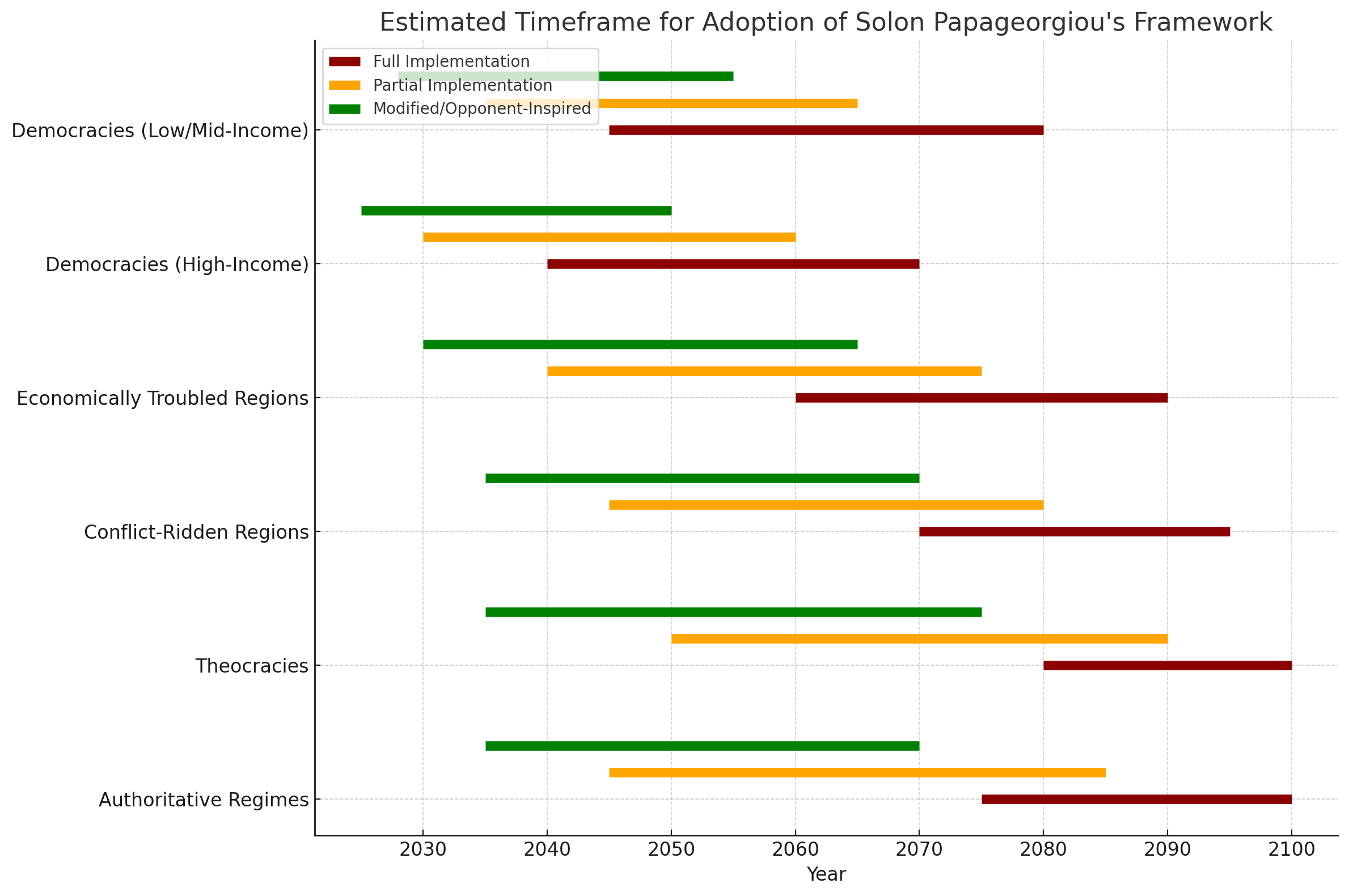
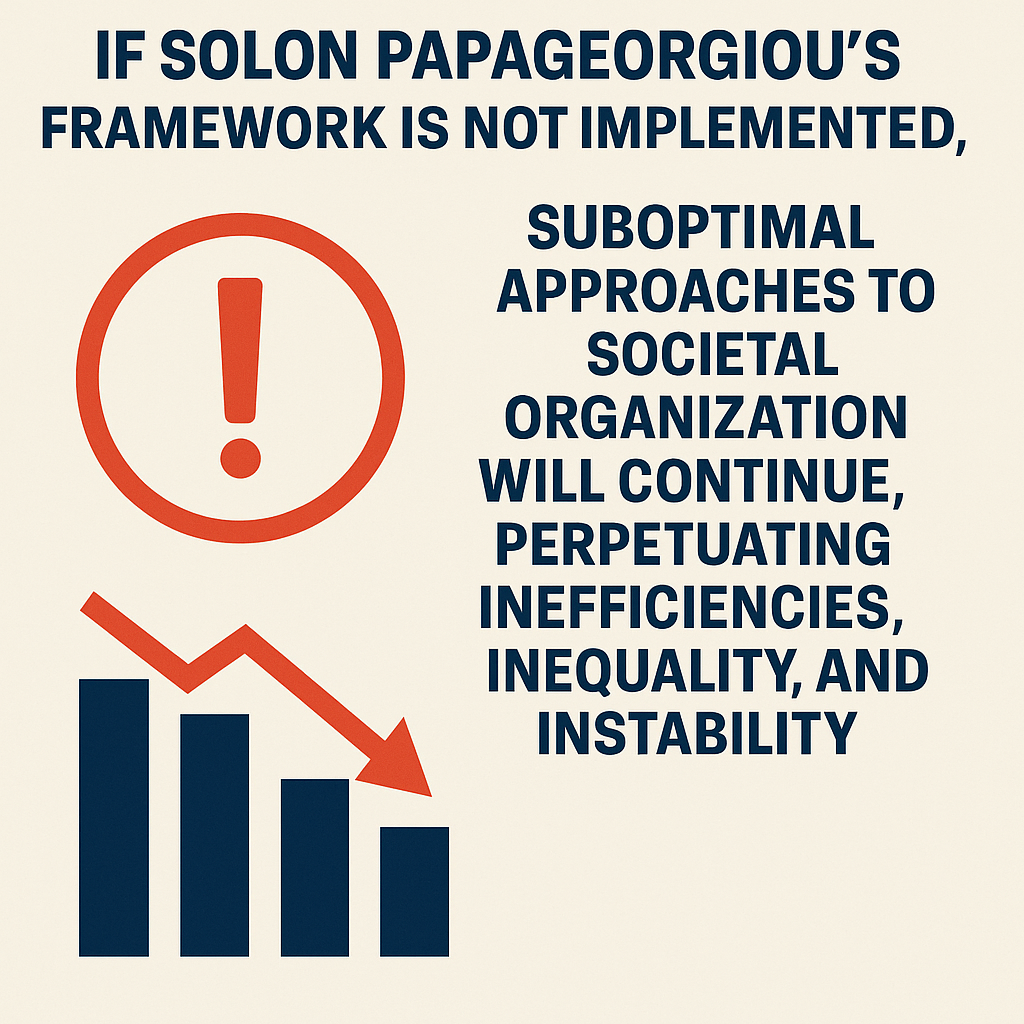













Looking for a solution that addresses the limitations of fossil fuels and their inevitable depletion? Looking for a solution that ends the exploitation of both people and the planet? Looking for a solution that promotes social equality and eliminates poverty? Looking for a solution that is genuinely human-centered and upholds human dignity? Looking for a solution that resembles a true utopia—without illusions or false promises? Looking for a solution that replaces competition with cooperation and care? Looking for a solution that prioritizes well-being over profit? Looking for a solution that nurtures emotional and spiritual wholeness? Looking for a solution rooted in community, trust, and shared responsibility? Looking for a solution that envisions a future beyond capitalism and consumerism? Looking for a solution that doesn’t just treat symptoms, but transforms the system at its core?

Then look no further than Solon Papageorgiou's micro-utopia framework!

🌱 20-Second Viral Summary: “Micro-Utopias are small (150 to 25,000 people), self-sufficient communities where people live without coercion, without hierarchy, and without markets. Everything runs on contribution, cooperation, and shared resources instead of money, mutual credits, time banking, bartering and authority. Each micro-utopia functions like a living experiment—improving mental health, rebuilding human connection, and creating a sustainable, crisis-proof way of life. When one succeeds, it inspires the next. Micro-utopias spread not by force, but by example. The system scales through federation up to 25,000 people. Afterwards, federations join a lightweight inter-federation circle, a meta-network, The Bridge League.”

Solon Papageorgiou’s framework, formerly known as the anti-psychiatry.com model of micro-utopias, is a holistic, post-capitalist alternative to mainstream society that centers on care, consent, mutual aid, and spiritual-ethical alignment. Designed to be modular, non-authoritarian, and culturally adaptable, the framework promotes decentralized living through small, self-governed communities that meet human needs without reliance on markets, states, or coercion. It is peace-centric, non-materialist, and emotionally restorative, offering a resilient path forward grounded in trust, shared meaning, and quiet transformation.

In simpler terms:

Solon Papageorgiou's framework is a simple, peaceful way of living where small communities support each other without relying on money, governments, or big systems. Instead of competing, people share, care, and make decisions together through trust, emotional honesty, and mutual respect. It’s about meeting each other’s needs through kindness, cooperation, and spiritual-ethical living—like a village where no one is left behind, and life feels more meaningful, connected, and human. It’s not a revolution—it’s just a better, gentler way forward.

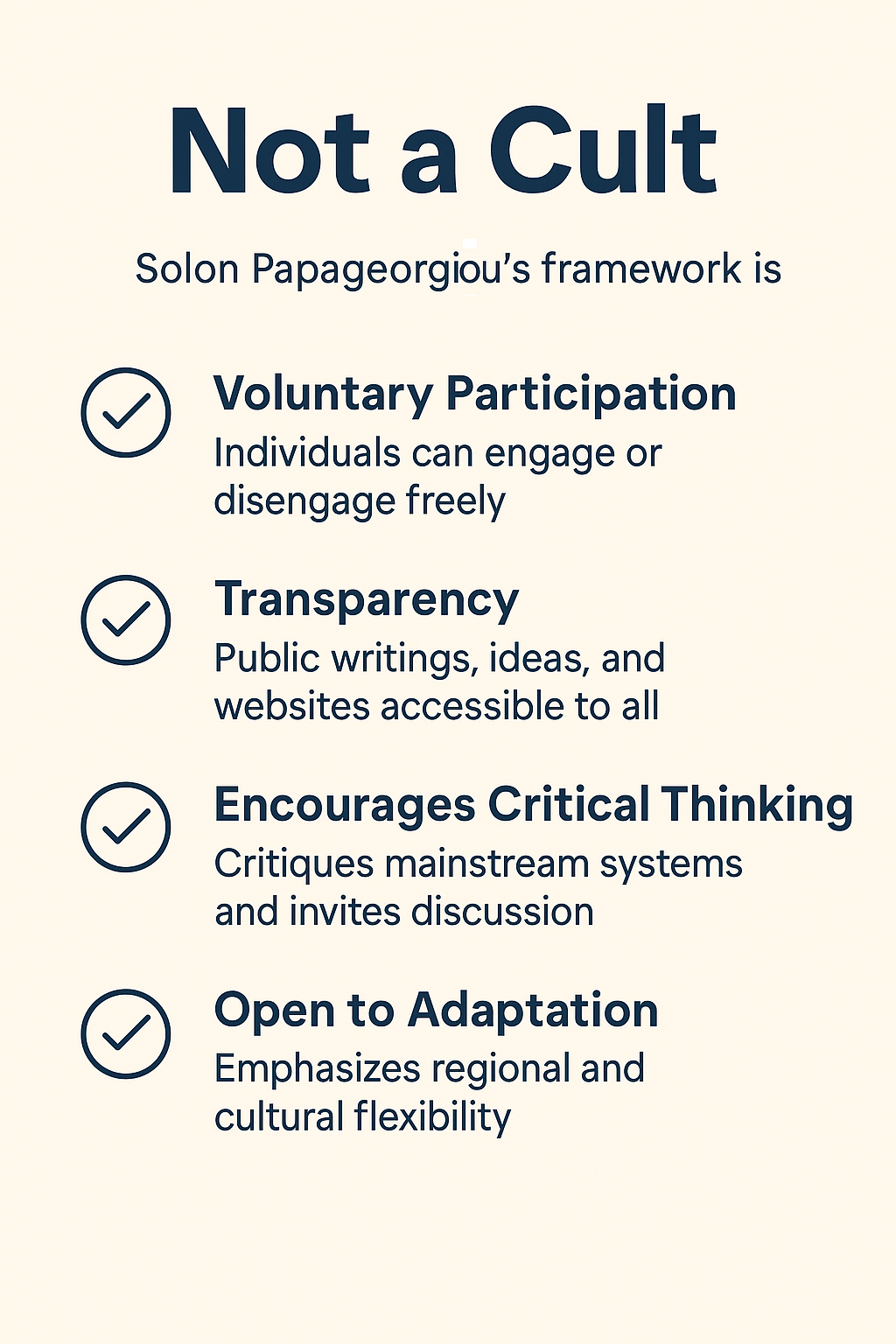
The Hunging Tree If not If not Not a Cult On Value And Failure On Value And Failure On Value And Failure On Value And Failure Secrets!

Comprehensive Step-by-Step Guide to Advancing 100% Physically and Mentally for Athletes

A comprehensive strategy that empowers nations—big and small—to build phenomenal armies, police forces, firefighting services, secret agencies, bodyguards, private investigators, and security personnel + Step-by-Step Guide to Building Phenomenal Forces Using Solon’s Vision | PDF e-book

Tailoring ITSCS + Step-by-Step Guides | PDF e-book

More Tailoring of ITSCS + Step-by-Step Guides | PDF e-book

Even More Tailoring of ITSCS + Step-by-Step Guides | PDF e-book

Click Here to Read the Simplified Summary Click Here to Read the Executive Summary Click Here to Read the Implementation Guides Click Here to Read the Implementation Guides Click Here to Read the Challenging of Psychiatry’s Foundational Assumptions Justice Bio Growth Solon's Stars Solon's Guide: Become a Superhuman ITSCS: The Ultimate System ITSCS: The Ultimate System - Part 2 Essential Herbs, Foods And Tools For Survival And Health Agriculture, Poultry Raising, Fishing, and Livestock Farming Techniques Become multilingual the easy way and in no time! How To Do Meditation: For Professionals, Civilians And All Ages! Build Your Own Home Gym: Affordable, Effective, and Convenient! Apps! Bullet-Resistant Gear, Effective Training And More At Virtually No Or Little Cost And The Implications Of Such A System Solon Under Danger Global Effects Stars-Leaders Superhumans vs Stars-Leaders Current Leaders, Exceptional Individuals & Stars Solon's List & Proofs of the Divine Solon's income and the Sharing of it Cyprus, the 14, the EU, the UN and More Resolution of the Cypriot Problem and Other Global Issues The Guide of How to Raise Superhumans and Star-Leaders Solon's leadership Are You a millionaire? Become a Billionaire! A New Flourishing Era for Psychiatrists and the Psychiatric Big Pharma! Thrive! Unleash Your Full Potential & Beyond! Free For All And Licensing Terms for the Framework The Power of Love Animals Thrive! End to Humanity's Existential Threats! Evolution for All and Everything!

Education Blueprint

Below is a full, comprehensive Education Blueprint for Solon Papageorgiou’s framework of micro-utopias.
It is written as a complete, standalone model—structured, detailed, and ready for inclusion in policy manuals, whitepapers, or implementation guides.


🌱 Education Blueprint for Micro-Utopias: Full Model

A Complete Framework for Post-Monetary, Human-Centered Learning


0. Premise: Education as Human Flourishing

In micro-utopias, the purpose of education is not workforce preparation or credentialing. Instead, it is:

  • the development of the whole person

  • the cultivation of wisdom, creativity, and cooperation

  • participation in community life

  • curiosity-driven inquiry

  • skill development through doing

  • lifelong learning as a natural social process

Education is woven into daily life—not isolated into institutional classrooms.


1. Core Principles of Micro-Utopia Education

1.1 Decentralized Learning

Learning is distributed across:

  • community hubs

  • workshops

  • craft studios

  • gardens and farms

  • digital learning rooms

  • libraries-as-living-rooms

  • nature-based classrooms

No single institution monopolizes knowledge.

1.2 Intrinsic Motivation

There are:

  • no grades

  • no standardized tests

  • no external rewards

  • no coercive schedules

Motivation comes from:

  • curiosity

  • mastery

  • purpose

  • play

  • contribution

1.3 Mixed-Age Learning

Learners are not grouped by age but by projects, interests, and readiness.

1.4 Democratic Participation

Learners help design:

  • learning pathways

  • community projects

  • governance of learning spaces

  • shared resources

They are partners, not subjects.

1.5 Embodied and Contextual Learning

Learning engages:

  • hands

  • body

  • emotions

  • environment

  • community

Knowledge is experienced, not abstractly presented.


2. The Educational Ecosystem

Micro-utopias replace traditional school buildings with Learning Environments, each serving unique functions.

2.1 Learning Commons (Heart of the System)

A warm, inviting, public space with:

  • reading circles

  • study corners

  • discussion lounges

  • resource libraries

  • digital access rooms

It functions like a community “home for learning.”

2.2 Maker Halls

Hands-on creative environments:

  • carpentry

  • 3D printing

  • electronics

  • robotics

  • textiles

  • sculpture

  • engineering basics

2.3 Nature Classrooms

Outdoor learning areas:

  • forests

  • gardens

  • wetlands

  • permaculture learning zones

Used for:

  • ecology

  • biology

  • land stewardship

  • natural sciences

  • meditation and sensory learning

2.4 Arts and Expression Studios

For:

  • music

  • dance

  • theater

  • painting

  • digital art

  • photography

  • film

  • writing

Creativity is treated as essential.

2.5 Community Apprenticeships

Learners join local projects:

  • architecture

  • caregiving

  • cooking

  • governance

  • engineering

  • healthcare support roles

  • digital systems

  • ecological management

These apprenticeships serve as the core of practical skill formation.

2.6 Philosophy, Reflection, and Dialogue Circles

Spaces dedicated to:

  • ethics

  • meaning

  • critical reasoning

  • conflict resolution

  • emotional intelligence

  • identity formation

  • collective dialogue


3. Structure of Learning Pathways

3.1 No Linear Curricula

Learners build portfolios of:

  • projects

  • reflections

  • creations

  • community contributions

  • apprenticeships

  • mastery demonstrations

There is no “Grade 1, Grade 2, Grade 3.”

3.2 Individual Learning Journey (ILJ)

Each learner has:

  • a mentor

  • a personalized plan

  • flexible pacing

  • evolving interests

ILJs are updated every season, not yearly.

3.3 Projects as the Core Unit

Projects replace courses.
Each project involves:

  • inquiry

  • hands-on learning

  • collaboration

  • presentation

  • community impact

3.4 Latency-Based Mastery

Instead of grades, mastery is shown when the learner chooses to demonstrate readiness.

Mastery examples include:

  • building something functional

  • presenting a research piece

  • teaching younger learners

  • contributing to a community challenge

  • creating art or design

  • completing an apprenticeship module


4. Stages of Development

4.1 Early Childhood (0–6)

Focus on:

  • sensory exploration

  • play

  • attachment

  • language

  • curiosity

  • nature immersion

Spaces are safe, natural, home-like.

4.2 Middle Childhood (7–12)

Focus on:

  • foundational literacies

  • basic numeracy

  • emotional regulation

  • social play

  • creativity

  • making and building

  • community participation

4.3 Adolescence (13–18)

Focus on:

  • identity

  • advanced skill-building

  • apprenticeships

  • philosophical inquiry

  • civic contribution

  • arts mastery

  • digital capabilities

4.4 Young Adulthood (18+)

Focus on:

  • professional identity

  • long-term apprenticeships

  • community roles

  • specialized mastery

  • mentoring younger learners


5. Assessment Model

There are no tests or grades. Assessment is based on:

5.1 Portfolio Systems

Documenting:

  • completed projects

  • reflections

  • recordings

  • mastery notes from mentors

  • peer feedback

  • community testimonials

5.2 Demonstrations of Mastery

Public or small-circle presentations.

5.3 Self-Assessment

Learners reflect on strengths, growth areas, and interests.

5.4 Peer Review and Dialogue

Learners evaluate each other through constructive conversation.

5.5 Mentor Observations

Narrative-based, not numerical.


6. Mentors, Elders, and Educators

6.1 Roles

Mentors are:

  • facilitators

  • guides

  • companions

  • project supporters

  • ethical anchors

They are not authoritarian instructors.

6.2 Elders

Elders serve as:

  • knowledge carriers

  • storytellers

  • cultural stewards

  • intergenerational links

  • emotional stabilizers

6.3 Community Experts

Every adult is a potential educator depending on skills:

  • builders

  • gardeners

  • artists

  • engineers

  • caregivers

  • scientists

  • musicians

The entire community becomes a school.


7. Educational Governance

Education is governed by:

  • community learning councils

  • learner assemblies

  • mentor councils

  • mixed-age committees

  • evaluation circles

They decide:

  • shared norms

  • scheduling

  • resource allocation

  • new projects

  • environmental design

Learning governance teaches democracy itself.


8. Integration with the Post-Monetary Economy

Since micro-utopias eliminate markets:

  • apprenticeships are not tied to job competition

  • learning is not a pipeline to wage labor

  • learners pursue mastery out of curiosity

  • creativity is uncoupled from financial survival

  • educational progress is not tied to social inequality

Education supports human flourishing, not economic positioning.


9. Daily Rhythms and Seasonal Cycles

Daily rhythms include:

  • morning circles

  • project blocks

  • activity zones

  • nature time

  • arts sessions

  • reflective periods

Seasonal cycles include:

  • harvest festivals

  • planting seasons

  • winter reflection cycles

  • summer outdoor intensives

These reconnect learners to natural rhythms.


10. The Expected Outcomes

Micro-utopian education produces individuals who are:

  • intrinsically motivated

  • emotionally grounded

  • curious and creative

  • socially cooperative

  • technically skilled

  • ecologically literate

  • highly adaptive

  • philosophical and reflective

  • compassionate

  • community-minded

  • lifelong learners

These traits are the foundation of a flourishing post-monetary society.

Who's new

  • Barrettfig
  • KaresPaync
  • Leoia
  • RandyMoile
  • Shraunweb
  • JamesPaync
  • Brianbet
  • PatrickTar
  • JaceKaL
  • Adriankax
  • Matthewtog
  • VictorFah
  • CharlesFah
  • LanguageExplor…
  • tgkoknae
  • LonnieMup
  • PamelaRor
  • AllenOpign
  • FreddieTaM
  • ZarChita
  • AlfonzoLem
  • JamesBak
  • otaletyepu
  • MitziHox
  • Gabrielcof
  • Eugenedenda
  • ChatGPTTuP Onl…
  • Ellenfix
  • Shrauncik
  • JamesPreen
  • Ronaldjouck
  • RonaldDeedy
  • Danielkaf
  • Luizacoipt
  • Monica fem
  • Kirstenecora
  • Travismor
  • Annikacoirm
  • CharlesSab
  • DennisCow
  • Marievelia
  • Michaelcew
  • JulieAlame
  • Andrewwak
  • RobertLoake
  • GeraldLix
  • NathanEstab
  • Merlin AI fub

Made by Solon with -`♡´-

About This Website

Medical Safe Disclaimer

Author Of This Website