



















Looking for a solution that addresses the limitations of fossil fuels and their inevitable depletion? Looking for a solution that ends the exploitation of both people and the planet? Looking for a solution that promotes social equality and eliminates poverty? Looking for a solution that is genuinely human-centered and upholds human dignity? Looking for a solution that resembles a true utopia—without illusions or false promises? Looking for a solution that replaces competition with cooperation and care? Looking for a solution that prioritizes well-being over profit? Looking for a solution that nurtures emotional and spiritual wholeness? Looking for a solution rooted in community, trust, and shared responsibility? Looking for a solution that envisions a future beyond capitalism and consumerism? Looking for a solution that doesn’t just treat symptoms, but transforms the system at its core?

Then look no further than Solon Papageorgiou's micro-utopia framework!

🌱 20-Second Viral Summary: “Micro-Utopias are small (150 to 25,000 people), self-sufficient communities where people live without coercion, without hierarchy, and without markets. Everything runs on contribution, cooperation, and shared resources instead of money, mutual credits, time banking, bartering and authority. Each micro-utopia functions like a living experiment—improving mental health, rebuilding human connection, and creating a sustainable, crisis-proof way of life. When one succeeds, it inspires the next. Micro-utopias spread not by force, but by example. The system scales through federation up to 25,000 people. Afterwards, federations join a lightweight inter-federation circle, a meta-network, The Bridge League.”

Solon Papageorgiou’s framework, formerly known as the anti-psychiatry.com model of micro-utopias, is a holistic, post-capitalist alternative to mainstream society that centers on care, consent, mutual aid, and spiritual-ethical alignment. Designed to be modular, non-authoritarian, and culturally adaptable, the framework promotes decentralized living through small, self-governed communities that meet human needs without reliance on markets, states, or coercion. It is peace-centric, non-materialist, and emotionally restorative, offering a resilient path forward grounded in trust, shared meaning, and quiet transformation.

In simpler terms:

Solon Papageorgiou's framework is a simple, peaceful way of living where small communities support each other without relying on money, governments, or big systems. Instead of competing, people share, care, and make decisions together through trust, emotional honesty, and mutual respect. It’s about meeting each other’s needs through kindness, cooperation, and spiritual-ethical living—like a village where no one is left behind, and life feels more meaningful, connected, and human. It’s not a revolution—it’s just a better, gentler way forward.

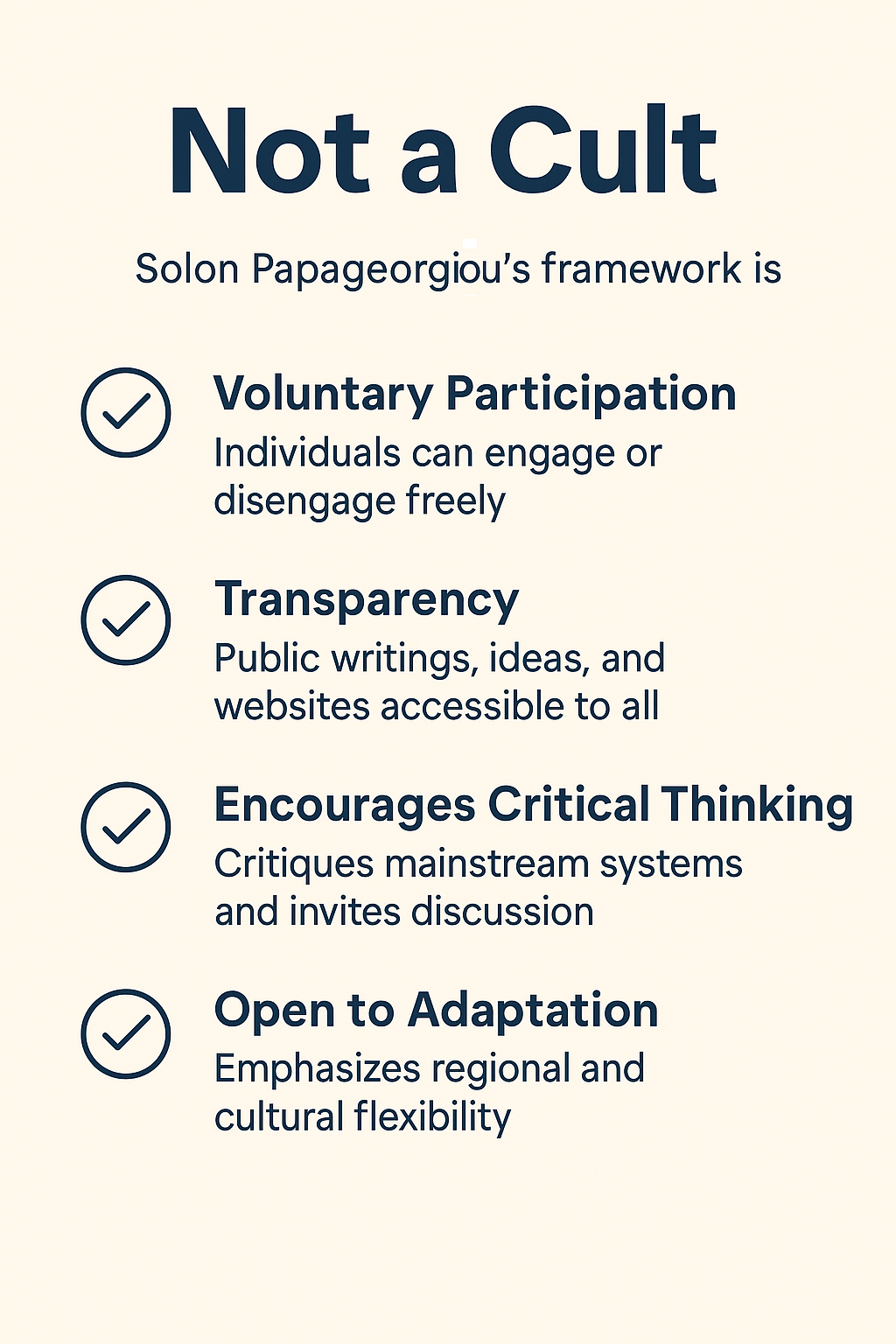
The Hunging Tree If not If not Not a Cult On Value And Failure On Value And Failure On Value And Failure On Value And Failure Secrets!

Comprehensive Step-by-Step Guide to Advancing 100% Physically and Mentally for Athletes

A comprehensive strategy that empowers nations—big and small—to build phenomenal armies, police forces, firefighting services, secret agencies, bodyguards, private investigators, and security personnel + Step-by-Step Guide to Building Phenomenal Forces Using Solon’s Vision | PDF e-book

Tailoring ITSCS + Step-by-Step Guides | PDF e-book

More Tailoring of ITSCS + Step-by-Step Guides | PDF e-book

Even More Tailoring of ITSCS + Step-by-Step Guides | PDF e-book

Click Here to Read the Simplified Summary Click Here to Read the Executive Summary Click Here to Read the Implementation Guides Click Here to Read the Implementation Guides Click Here to Read the Challenging of Psychiatry’s Foundational Assumptions Justice Bio Growth Solon's Stars Solon's Guide: Become a Superhuman ITSCS: The Ultimate System ITSCS: The Ultimate System - Part 2 Essential Herbs, Foods And Tools For Survival And Health Agriculture, Poultry Raising, Fishing, and Livestock Farming Techniques Become multilingual the easy way and in no time! How To Do Meditation: For Professionals, Civilians And All Ages! Build Your Own Home Gym: Affordable, Effective, and Convenient! Apps! Bullet-Resistant Gear, Effective Training And More At Virtually No Or Little Cost And The Implications Of Such A System Solon Under Danger Global Effects Stars-Leaders Superhumans vs Stars-Leaders Current Leaders, Exceptional Individuals & Stars Solon's List & Proofs of the Divine Solon's income and the Sharing of it Cyprus, the 14, the EU, the UN and More Resolution of the Cypriot Problem and Other Global Issues The Guide of How to Raise Superhumans and Star-Leaders Solon's leadership Are You a millionaire? Become a Billionaire! A New Flourishing Era for Psychiatrists and the Psychiatric Big Pharma! Thrive! Unleash Your Full Potential & Beyond! Free For All And Licensing Terms for the Framework The Power of Love Animals Thrive! End to Humanity's Existential Threats! Evolution for All and Everything!

“How to Start Your First 300-Person Village” step-by-step guide

Here’s a complete, structured step-by-step guide for starting your first 300-person micro-utopia village, fully aligned with Solon Papageorgiou’s post-monetary, post-market, federated framework.


📘 How to Start Your First 300-Person Village: Step-by-Step Guide


Step 1: Form the Founding Circle

  • Size: 12–20 committed members

  • Diversity: Include skills in community coordination, health, food production, education, construction, technology, and conflict mediation

  • Commitment: Minimum 1–2 years of active participation during establishment

  • Tasks:

    • Draft vision and values

    • Create decision-making principles

    • Establish communication channels

    • Identify essential roles for early infrastructure

Tip: Keep circles small and trust-based to ensure early cohesion.


Step 2: Secure Land

  • Size: 8–12 hectares (20–30 acres)

  • Considerations:

    • Water availability (groundwater, rivers, rain capture potential)

    • Solar access for energy

    • Soil quality for gardens and orchards

    • Accessibility (roads, paths)

    • Proximity to federation partners (optional)

  • Legal: Ensure community ownership or long-term cooperative lease, avoiding market speculation


Step 3: Design Village Layout

  • Central Ring: shared spaces (kitchen, community hub, health, education, studios)

  • Housing Clusters: modular micro-homes and family units in outer ring

  • Green Spine: food forests, gardens, walking paths, ecological corridors

  • Infrastructure: energy hub, water treatment, waste management, workshops

Tip: Keep everything within a 5-minute walk to maximize interaction and cooperation.


Step 4: Plan Basic Infrastructure

  • Energy: rooftop solar, batteries, microgrid; optional wind micro-turbines

  • Water: rain capture, greywater recycling, filtration, constructed wetlands

  • Sanitation: compost toilets, bio-digesters, ecological sewage

  • Food Systems: food forests, gardens, greenhouses, seed banks

  • Workshops: crafts, repair, 3D printing, adaptive technology

  • Health: small clinic/health hub for primary care and wellness

  • Communication: mesh networks, local radio, dashboards for coordination


Step 5: Recruit Early Residents

  • Target: 50–100 people for initial settlement

  • Criteria: Shared values, willingness to contribute, diverse skills

  • Process:

    • Open applications and interviews

    • Trial visits or “residency weeks”

    • Establish contribution circles early

Tip: Early residents shape village culture; choose people who thrive in collaboration.


Step 6: Build Essential Structures

Start with minimal infrastructure to support early life:

  1. Housing units (modular, temporary or permanent)

  2. Community kitchen and dining hall

  3. Water and sanitation systems

  4. Health hub / wellness room

  5. Seed storage and garden plots

Other structures (workshops, studios) come online as capacity grows.


Step 7: Establish Governance & Contribution System

  • Governance Circles:

    • Housing & construction

    • Food & agriculture

    • Health & wellness

    • Education & skills

    • Logistics & transport

    • Culture & arts

  • Decision-making: consensus or super-majority for critical issues

  • Contribution: voluntary, rotation-based, task-oriented (no hours, no credits, no money)

  • Conflict Resolution: mediation circles, peer accountability, restorative practices


Step 8: Develop Food & Nutrition Systems

  • Start with high-yield gardens and small food forests

  • Assign Food Guilds for planting, harvesting, preparation

  • Begin central meal cycles to create social cohesion

  • Plan surplus for federation exchange and seasonal variability

Tip: Early successes in food production boost morale and participation.


Step 9: Launch Education & Learning Circles

  • Multi-age, skill-based, self-directed learning

  • Assign mentors and facilitators

  • Begin apprenticeships in agriculture, construction, health, arts, and tech

  • Encourage peer-to-peer learning and cross-age collaboration


Step 10: Integrate Healthcare & Wellness

  • Establish a Health Circle for first aid, preventative care, and wellness check-ins

  • Identify local and federation specialists for tele-consult support

  • Include mental wellness circles and peer support systems

  • Provide training for all residents in basic emergency care


Step 11: Scale & Expand to Full 300 Residents

  • Gradually bring in new residents in 50–75 person cohorts

  • Ensure infrastructure grows in step with population

  • Maintain contribution culture and governance integrity

  • Expand housing clusters and workshops as needed


Step 12: Connect to Federation

  • Share resources, specialists, and knowledge with neighboring villages

  • Rotate mobile teams (health, repair, education, workshops)

  • Participate in federation-wide planning, exchange, and skill-sharing

  • Maintain local autonomy while benefiting from federation support


Step 13: Maintain Sustainability & Culture

  • Continuous training and mentorship

  • Regular reflection and evaluation circles

  • Iterative design updates to housing, green spaces, and infrastructure

  • Encourage cultural, artistic, and recreational activities

  • Foster intergenerational interaction (children, adults, elders)


Step 14: Emergency Preparedness

  • Fire, flood, or power failure plans

  • Mobile response teams and federation backup

  • Evacuation routes and shelters

  • Redundant energy, water, and food systems


Step 15: Celebrate & Anchor the Community

  • Annual or quarterly festivals, meals, arts showcases

  • Publicly recognize contributions and milestones

  • Share lessons learned with other micro-utopias

  • Solidify village identity while remaining open to federation collaboration


Key Takeaways

  • Start small, expand gradually

  • Build culture before buildings

  • Contribution replaces money, credit, and enforcement

  • Federation connections provide safety nets and skill circulation

  • Every resident is a co-designer and co-owner (without private property or rent)

  • The 300-person village is the optimal building block for a federated post-monetary society

Who's new

  • Barrettfig
  • KaresPaync
  • Leoia
  • RandyMoile
  • Shraunweb
  • JamesPaync
  • Brianbet
  • PatrickTar
  • JaceKaL
  • Adriankax
  • Matthewtog
  • VictorFah
  • CharlesFah
  • LanguageExplor…
  • tgkoknae
  • LonnieMup
  • PamelaRor
  • AllenOpign
  • FreddieTaM
  • ZarChita
  • AlfonzoLem
  • JamesBak
  • otaletyepu
  • MitziHox
  • Gabrielcof
  • Eugenedenda
  • ChatGPTTuP Onl…
  • Ellenfix
  • Shrauncik
  • JamesPreen
  • Ronaldjouck
  • RonaldDeedy
  • Danielkaf
  • Luizacoipt
  • Monica fem
  • Kirstenecora
  • Travismor
  • Annikacoirm
  • CharlesSab
  • DennisCow
  • Marievelia
  • Michaelcew
  • JulieAlame
  • Andrewwak
  • RobertLoake
  • GeraldLix
  • NathanEstab
  • Merlin AI fub

Made by Solon with -`♡´-

About This Website

Medical Safe Disclaimer

Author Of This Website