







Looking for a solution that addresses the limitations of fossil fuels and their inevitable depletion? Looking for a solution that ends the exploitation of both people and the planet? Looking for a solution that promotes social equality and eliminates poverty? Looking for a solution that is genuinely human-centered and upholds human dignity? Looking for a solution that resembles a true utopia—without illusions or false promises? Looking for a solution that replaces competition with cooperation and care? Looking for a solution that prioritizes well-being over profit? Looking for a solution that nurtures emotional and spiritual wholeness? Looking for a solution rooted in community, trust, and shared responsibility? Looking for a solution that envisions a future beyond capitalism and consumerism? Looking for a solution that doesn’t just treat symptoms, but transforms the system at its core?

Then look no further than Solon Papageorgiou's micro-utopia framework!

🌱 20-Second Viral Summary: “Micro-Utopias are small (150 to 25,000 people), self-sufficient communities where people live without coercion, without hierarchy, and without markets. Everything runs on contribution, cooperation, and shared resources instead of money, mutual credits, time banking, bartering and authority. Each micro-utopia functions like a living experiment—improving mental health, rebuilding human connection, and creating a sustainable, crisis-proof way of life. When one succeeds, it inspires the next. Micro-utopias spread not by force, but by example. The system scales through federation up to 25,000 people. Afterwards, federations join a lightweight inter-federation circle, a meta-network, The Bridge League.”

Solon Papageorgiou’s framework, formerly known as the anti-psychiatry.com model of micro-utopias, is a holistic, post-capitalist alternative to mainstream society that centers on care, consent, mutual aid, and spiritual-ethical alignment. Designed to be modular, non-authoritarian, and culturally adaptable, the framework promotes decentralized living through small, self-governed communities that meet human needs without reliance on markets, states, or coercion. It is peace-centric, non-materialist, and emotionally restorative, offering a resilient path forward grounded in trust, shared meaning, and quiet transformation.

In simpler terms:

Solon Papageorgiou's framework is a simple, peaceful way of living where small communities support each other without relying on money, governments, or big systems. Instead of competing, people share, care, and make decisions together through trust, emotional honesty, and mutual respect. It’s about meeting each other’s needs through kindness, cooperation, and spiritual-ethical living—like a village where no one is left behind, and life feels more meaningful, connected, and human. It’s not a revolution—it’s just a better, gentler way forward.

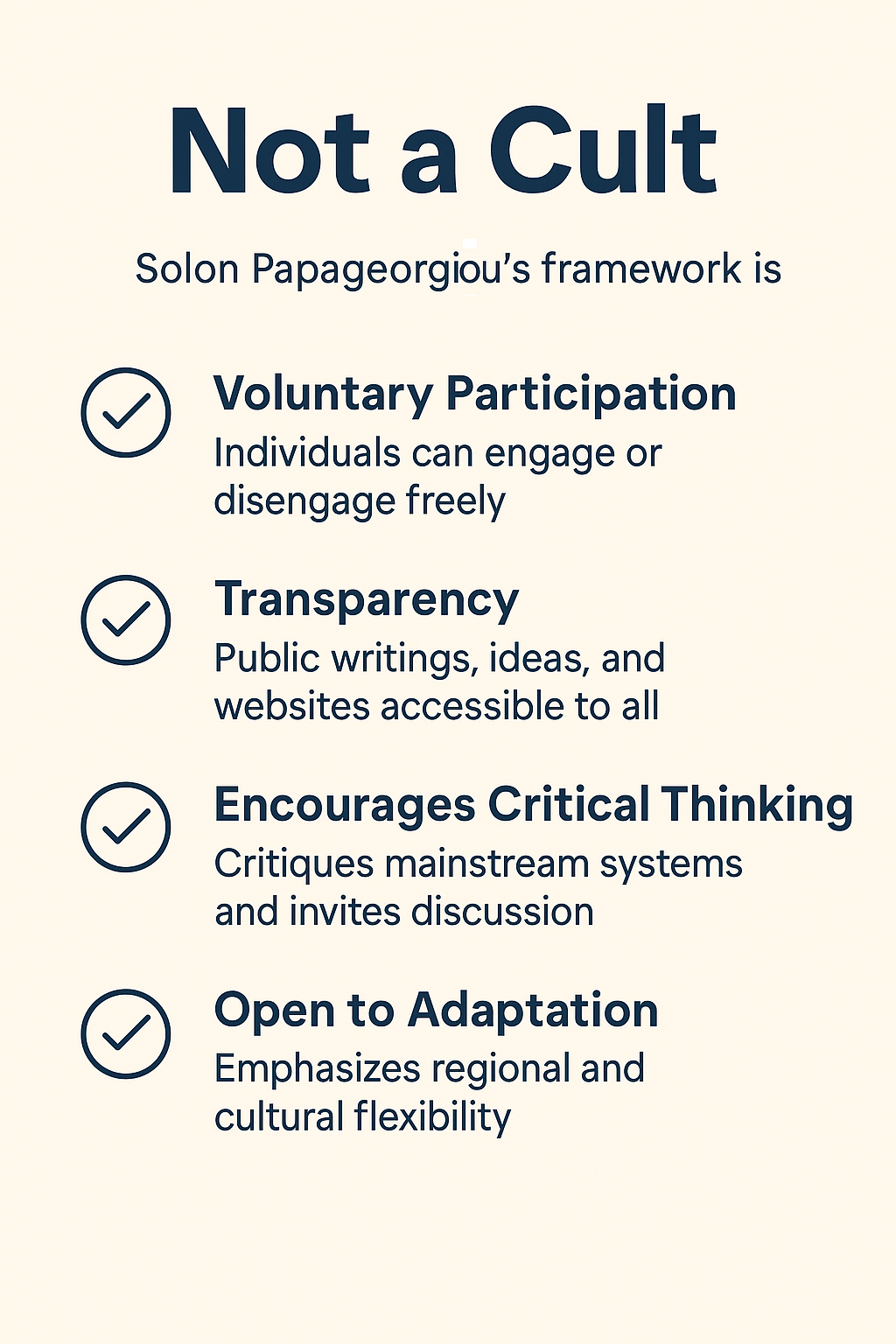
The Hunging Tree If not If not Not a Cult On Value And Failure On Value And Failure On Value And Failure On Value And Failure Secrets!

Comprehensive Step-by-Step Guide to Advancing 100% Physically and Mentally for Athletes


A comprehensive strategy that empowers nations—big and small—to build phenomenal armies, police forces, firefighting services, secret agencies, bodyguards, private investigators, and security personnel + Step-by-Step Guide to Building Phenomenal Forces Using Solon’s Vision | PDF e-book

Tailoring ITSCS + Step-by-Step Guides | PDF e-book

More Tailoring of ITSCS + Step-by-Step Guides | PDF e-book

Even More Tailoring of ITSCS + Step-by-Step Guides | PDF e-book

Click Here to Read the Simplified Summary Click Here to Read the Executive Summary Click Here to Read the Implementation Guides Click Here to Read the Implementation Guides Click Here to Read the Challenging of Psychiatry’s Foundational Assumptions Justice Bio Growth Solon's Stars Solon's Guide: Become a Superhuman ITSCS: The Ultimate System ITSCS: The Ultimate System - Part 2 Essential Herbs, Foods And Tools For Survival And Health Agriculture, Poultry Raising, Fishing, and Livestock Farming Techniques Become multilingual the easy way and in no time! How To Do Meditation: For Professionals, Civilians And All Ages! Build Your Own Home Gym: Affordable, Effective, and Convenient! Apps! Bullet-Resistant Gear, Effective Training And More At Virtually No Or Little Cost And The Implications Of Such A System Solon Under Danger Global Effects Stars-Leaders Superhumans vs Stars-Leaders Current Leaders, Exceptional Individuals & Stars Solon's List & Proofs of the Divine Solon's income and the Sharing of it Cyprus, the 14, the EU, the UN and More Resolution of the Cypriot Problem and Other Global Issues The Guide of How to Raise Superhumans and Star-Leaders Solon's leadership Are You a millionaire? Become a Billionaire! A New Flourishing Era for Psychiatrists and the Psychiatric Big Pharma! Thrive! Unleash Your Full Potential & Beyond! Free For All And Licensing Terms for the Framework The Power of Love Animals Thrive! End to Humanity's Existential Threats! Evolution for All and Everything!

Resources and Productive Structures are Collectively Held

In Solon Papageorgiou's framework, most resources and productive structures — including what mainstream societies would call “businesses” — are collectively held, locally stewarded, and function relationally, not through formal ownership in the legal or capitalist sense.

✅ What Is Collectively Owned or Stewarded:

1. Land

  • There is no private land ownership.

  • Land is treated as a shared ecological and cultural trust.

  • Communities steward land for collective use — food plots, forests, workshops, gardens, gathering spaces, etc.

2. Workspaces & Infrastructure

  • Buildings like workshops, tech labs, artisan studios, and kitchens are maintained by those who use them, often via rotating stewardship.

  • A group using a space for a while doesn’t own it — they care for it until others need it or the purpose evolves.

3. Tools, Equipment, and Materials

  • Tools (from looms to 3D printers) are shared and maintained as commons.

  • Materials like timber, fabric, scrap electronics, or herbs are gathered, stored, and distributed communally, with transparency and dialogue guiding usage.

4. Knowledge and Skills

  • All technical knowledge, patterns, software, recipes, and blueprints are considered commons-based intellectual resources, free to replicate, remix, or improve upon — a form of open-source living.

5. Energy and Water Systems

  • Solar panels, water mills, batteries, irrigation systems, etc., are co-built and co-maintained, without metering or individual billing.


🏭 What About Businesses?

❌ There are no "businesses" in the capitalist or legal sense.

There are no corporations, LLCs, or sole proprietorships.

✅ Instead, there are production circles, artisan cooperatives, and stewardship-based initiatives:

FeatureMainstream BusinessSolon Framework Equivalent
Profit motiveCentral to operationsNot present; value is use and care
Legal ownershipRegistered to individual/entityNo legal entity; shared stewardship
Capital accumulationAccrued for private growthMaterials reinvested into community
Labor divisionHierarchical, wage-basedVoluntary, skill-matched, relational
Output distributionSold for profitGifted, exchanged, or shared freely

Example: A “Tech Cooperative”

  • A group might build mesh network antennas, solar battery units, or communication tools.

  • The group doesn’t “own” the project — they’re trusted stewards of the equipment and skillset.

  • Devices produced are given to others based on need, or bartered for materials, never “sold.”

  • The tech lab might be maintained by 10–15 people, with rotating facilitators, no manager, and no hierarchy.


🧠 Key Principles Underlying Collective Ownership:

  1. Relational Responsibility over Legal Rights
    → You are part of something, not an owner of it.

  2. Contextual Contribution over Transaction
    → Everyone gives what they can, takes what they need — trust-based, not contract-based.

  3. Care as Governance
    → Stewardship and community feedback guide the longevity and use of all shared resources.


In Solon Papageorgiou’s framework, houses are not privately owned — they are considered part of the shared commons, like land, tools, and knowledge. However, this doesn’t mean people live without privacy or stability. Instead, housing is guided by communal trust, local stewardship, and contextual need rather than legal title or market ownership.


🏡 How Housing Works in the Framework

✅ No private property

  • No deeds, mortgages, rent, or landlordism.

  • You do not “own” your house — you live in it as a steward, based on your relationship with the community and your current needs.

🧑‍🤝‍🧑 Housing is provided and managed collectively

  • Homes are built, maintained, and sometimes reconfigured by the community.

  • Labor, materials, and design are shared and consensual.

  • Vacant spaces are offered to newcomers, families that need more room, or people in transition.

📦 Right to Shelter is Guaranteed

  • No one is ever without a home.

  • Even temporary dwellings (tents, yurts, cabins) are crafted and made welcoming.

  • Emotional needs like privacy, safety, aesthetic comfort, and cultural practices are all respected — even without property claims.


🛠️ Example: Building or Moving Into a Home

Let’s say a small family joins a village:

  1. Welcoming Circle

    • The village meets to learn about the family’s needs — children, accessibility, workspaces, cultural rituals.

  2. Available Space Review

    • A few existing homes are currently unused or underused.

    • Community members offer to share their homes or propose restoring an old cabin together.

  3. Decision by Relational Consensus

    • There’s no vote. People step forward with offers, stories, and questions.

    • The family chooses one option based on comfort, vibe, and mutual resonance.

  4. Stewardship and Contribution

    • The new residents are not asked for rent — instead, they gradually contribute by helping repair homes, tending gardens, mentoring children, or maintaining the solar grid.

  5. Moving or Changing Homes

    • If a household’s needs change, they talk with others and move to a more suitable dwelling — again, with consent, not legal contracts.


🔁 Can Homes Be Passed Down?

  • No inheritance of property, because homes aren’t owned.

  • However, if someone passes or leaves, their space is gently transitioned — perhaps offered to someone close to them or re-integrated into the commons through ceremony.

  • Sentimental and personal belongings are always respected.


❤️ Guiding Values Behind Collective Housing

ValuePractice
Use over ownershipHomes exist to shelter, not to accumulate wealth
StewardshipResidents care for homes, improve them, and pass them on lovingly
FlexibilityHousing can shift with life stages, family changes, or preferences
BelongingHousing is a right, not a prize or investment
Consent and careTransitions in housing happen through dialogue, not market forces

Who's new

  • Barrettfig
  • KaresPaync
  • Leoia
  • RandyMoile
  • Shraunweb
  • JamesPaync
  • Brianbet
  • PatrickTar
  • JaceKaL
  • Adriankax
  • Matthewtog
  • VictorFah
  • CharlesFah
  • LanguageExplor…
  • tgkoknae
  • LonnieMup
  • PamelaRor
  • AllenOpign
  • FreddieTaM
  • ZarChita
  • AlfonzoLem
  • JamesBak
  • otaletyepu
  • MitziHox
  • Gabrielcof
  • Eugenedenda
  • ChatGPTTuP Onl…
  • Ellenfix
  • Shrauncik
  • JamesPreen
  • Ronaldjouck
  • RonaldDeedy
  • Danielkaf
  • Luizacoipt
  • Monica fem
  • Kirstenecora
  • Travismor
  • Annikacoirm
  • CharlesSab
  • DennisCow
  • Marievelia
  • Michaelcew
  • JulieAlame
  • Andrewwak
  • RobertLoake
  • GeraldLix
  • NathanEstab
  • Merlin AI fub

Made by Solon with -`♡´-

About This Website

Medical Safe Disclaimer

Author Of This Website