




When we say “cultural integration is rooted” in the context of Solon Papageorgiou’s framework, it means that each micro-utopia is deeply grounded in the local culture, traditions, language, and lived history of the people who form it — rather than being imposed from the outside.
🟤 Here's what this implies in detail:
1. Built from the inside out
The framework is not a “one-size-fits-all” export.
It starts with the existing wisdom, practices, and values of the local community — whether Indigenous, rural, urban, religious, artistic, or spiritual.
2. Non-colonial
It avoids missionary attitudes — there's no attempt to “civilize,” evangelize, or convert.
Instead of telling people what should be, the framework asks:
“What do you already know, love, remember, and honor? Let’s build from there.”
3. Cultural “first nature”
Rather than treating culture as “added on” to a neutral system, culture is foundational.
Art, ritual, language, storytelling, music, and memory are woven into governance, conflict resolution, education, and daily life.
4. Local resilience
Rooted cultural integration allows micro-utopias to feel natural and familiar to their members.
This boosts resilience, pride, emotional well-being, and intergenerational continuity.
5. Multiple expressions
A micro-utopia in rural Bolivia will not look like one in Greece, Senegal, or Japan — and that’s by design.
Yet they all share ethical foundations: peace, autonomy, mutual care, sacredness, and dignity.
✅ In short:
“Cultural integration is rooted” means the framework doesn’t erase or override local identities.
Instead, it grows with them — like seeds planted in the soil of each culture’s deepest truths.
🔤 Language and labeling is non-evangelical
The framework avoids trying to “convert” people or preaching ideology.
It doesn't use rigid labels like "left" or "right", or even "utopian".
People live the values, not just talk about them.
It’s about living differently, not selling a new belief system.
🔧 Technological view is open to selective, ethical use of low-impact tech
It’s not anti-technology, but tech must serve people, not dominate them.
Favors low-energy, locally repairable, sustainable tech.
High-tech is used only when it fits the values, not for profit or control.
Think solar panels, open-source tools, community mesh networks — not surveillance or automation that replaces human dignity.
🌍 Cultural universality is designed for global diversity, adaptable anywhere
The model is flexible, not tied to one culture, religion, or nation.
It works in cities, villages, deserts, or forests — because it’s about principles, not a template.
A framework that adapts to the local soul, not replaces it.
🔁 Expansion model is fractal replication of micro-utopias worldwide
Rather than growing through central control, it spreads like cells — small, local, self-contained.
Each micro-utopia can inspire and mentor others without becoming a headquarters.
Like a mushroom network: decentralized, resilient, and hard to destroy.
🧬 Identity model is post-tribal, universalist, ethical-not-ethnic
Identity is not based on race, nation, religion, or ideology.
It focuses on shared ethics, sacredness, care, and inclusion.
You are part of the community because you care and live ethically, not because you share ancestry or dogma.
🧩 Scale and ambition is fractal model designed for global, cellular adoption
The same principles work at any scale: from one household to a full town.
Fractal means it can replicate endlessly without needing centralization.
A way to change the world by changing one cell at a time, without top-down revolution.
🤝 Cultural integration is pluralist
It embraces many cultures, religions, and ways of life.
Encourages communities to draw from their own traditions, rituals, and art.
A Catholic, a Buddhist, a pagan, and an atheist could all co-create a micro-utopia—as long as they respect each other.
🌾 Collective ownership is entire local economy collectively held
Land, tools, resources, and key services are held by the community, not individuals or corporations.
Still allows personal space and items, but key infrastructure is shared.
You don’t “own” the farm — you belong to the living community that stewards it together.
🧭 Horizontal governance is fractal, cellular, horizontal
No rulers or bosses — decisions are made together, in small circles.
If one cell grows too big, it splits like a biological cell.
Leadership is rotational, local, accountable, not top-down.
🚔 Police & law is consensus + sacred ethos
No conventional police or courts.
Conflict is resolved through dialogue, restorative justice, and sacred community principles.
The ethics of care and respect replace the need for punishment and fear.
🌌 Spiritual orientation is mystic, poetic, pluralist, sacred without dogma
Welcomes spirituality, silence, ritual, and awe — but no religious rules or authorities.
People are free to express inner life in ways that are beautiful, meaningful, and healing.
The sacred is felt, lived, and shared — not imposed.
🧠 Summary in One Sentence:
Solon Papageorgiou’s framework is a post-capitalist, post-political, community-based model that grows organically, honors the sacred and the plural, uses ethical tech wisely, and allows people to live with dignity, beauty, and mutual care — without bosses, borders, or coercion.
✅ 1. Governance is fractal, cellular, consensus-based, with sacred ethos guiding interaction
Fractal: Each small unit (a “cell”) is structured the same way as the whole — just like branches of a tree mirror the tree itself.
Cellular: Communities are small and semi-autonomous, like cells in a living body.
Consensus-based: Decisions are made through discussion and agreement, not voting or coercion.
Sacred ethos: Instead of written laws or punishments, people are guided by shared spiritual and ethical principles — things like respect, kindness, and reverence for life.
✅ 2. Scale is fractal-global, scalable anywhere at small scale
You don’t need a whole country to implement it. A single home, neighborhood, or village can live this way.
Each small part is complete and functional on its own, but can connect harmoniously with other parts.
It grows like a pattern, not like an empire.
✅ 3. Replication Model is designed for fractal replication worldwide
There's no headquarters, no central leadership, no imposed blueprint.
Anyone, anywhere can start one, inspired by the principles — adapted to their culture and context.
Just like how crystals grow or mushrooms spread — naturally, repeating the same pattern.
✅ 4. Goal is global micro-utopian transformation of society from within
The goal is not to overthrow governments or compete with nations.
Instead, it builds a new way of life quietly, piece by piece, from inside everyday life.
Over time, the accumulated presence of these micro-utopias creates a new reality.
✅ 5. Scalable globally means fractally designed for any context
Whether you're in a city, forest, desert, or refugee camp — the system adapts.
The design is simple, resilient, and self-healing, like nature itself.
It doesn’t need a revolution — just a seed planted and allowed to grow.
🌱 Analogy: Like Nature
Think of Solon Papageorgiou’s framework like a forest of self-sustaining gardens:
Each garden grows on its own.
Together, they form a global ecosystem.
No one controls the forest, yet it thrives in harmony.
In Solon Papageorgiou's framework, the phrase "Risk of state retaliation is low (non-confrontational)" means that:
🌿 The micro-utopias are designed to avoid provoking governments or power structures.
They don't try to:
Challenge authority directly
Take over land illegally
Protest or rebel
Engage in political struggle
"Convert" people or start movements with loud slogans
Instead, they:
✅ Exit quietly and live differently
They form small, peaceful, self-sufficient communities that don't depend on the state or corporate systems.
They do not attack or criticize the state directly, making them less likely to be seen as a threat.
They may appear to be eco-villages, spiritual retreats, artist communes, or simple lifestyle choices — not revolutions.
✅ Stay decentralized and under the radar
They're not centralized, so there is no "headquarters" to target.
Each community is small, local, and often blends in culturally, which means they are harder to notice or suppress.
No leaders, no flags, no dogmas — nothing for the state to fear.
✅ Use culture, not confrontation
Their tools are rituals, art, cooperation, healing, education, ecology — not protests or campaigns.
They're more like a quiet evolution than a revolution.
📌 Summary for the Average Joe:
Solon's framework doesn’t try to fight the system head-on — it just walks away from it. It’s peaceful, small-scale, and blends in. That’s why governments are less likely to see it as a problem or come after it.
In Solon Papageorgiou’s framework, when we say the post-capitalist economy is “complete,” we mean that:
✅ It can fully replace the functions of a capitalist economy within the micro-utopia
There is no need for money, profit, banks, bosses, or corporations — because the framework offers a full alternative economic system that:
Provides everything people need to live well
Food, shelter, education, healthcare, art, culture, meaning — all are covered.
It’s not a partial system (like just bartering or just communal farming); it’s holistic.
Functions independently of the global economy
While early micro-utopias might still trade with the outside world, they are designed to not depend on it.
They use mutual aid, time banking, resource sharing, local production, and collective ownership to meet all needs locally.
Includes its own value system
Unlike capitalism, where value = money/profit, here value = wellbeing, contribution, connection, creativity, and sacredness.
It redefines wealth as shared harmony and sufficiency, not accumulation.
Works at a small scale without coercion
No forced labor, no unemployment, no poverty.
Everyone participates willingly, doing meaningful work in service to the community.
Is self-replicating and scalable
Any group can copy and adapt the model to their context.
The economic logic is modular, non-centralized, and portable.
🔁 In short:
“Complete” means the post-capitalist model inside the micro-utopia does everything capitalism does — but better, more ethically, and without creating inequality, waste, or dependency.
In Solon Papageorgiou’s framework, the phrase “the economic logic is modular, non-centralized, and portable” means the economy of each micro-utopia is:
✅ Modular
→ Small, Self-Contained Units That Can Combine or Function Alone
Each community (micro-utopia) runs its own local economic logic — like growing food, exchanging services, and managing shared tools — independently.
If one community thrives or fails, others are unaffected.
Modules can interlink (e.g., trade or collaborate), but they don’t rely on a single central economy.
💡 Think of it like LEGO blocks — each piece works on its own, but can also fit with others to build something larger.
✅ Non-Centralized
→ No Headquarters, No Single Authority, No Economic “Capital”
There’s no “center” that controls the flow of money, resources, or rules.
No World Bank. No Ministry of Finance. No big corporation pulling strings.
Each micro-utopia makes its own decisions, governs its own resources, and manages its own exchange systems (like bartering, time-banking, or gift economies).
💡 It’s like a swarm of bees — intelligent, coordinated, but leaderless.
✅ Portable
→ Can Be Carried, Replicated, or Adapted Anywhere
The economic model is not tied to geography, ideology, or a fixed infrastructure.
It can be launched in rural, urban, or even digital spaces.
It's simple and flexible enough to be started by a few people with basic resources.
You can “pack it up” and recreate it elsewhere — making it ideal for nomadic groups, hidden communities, or exiles.
💡 It’s like a seed: lightweight, adaptable, and able to grow anywhere with care.
🌍 Why This Matters:
This approach helps Solon Papageorgiou’s framework:
Thrive under hostile or repressive regimes.
Avoid collapse if one part fails.
Allow grassroots, decentralized growth without needing permission from the state or big investors.
Spread quietly but powerfully across the globe.
Here’s an example of daily life and economics inside a small post-capitalist micro-utopia following Solon Papageorgiou’s framework — explained in plain terms for the average person.
🏡 Welcome to “Elios” — a Micro-Utopia of 80 people
Elios is a peaceful, post-capitalist community nestled in the hills. It’s moneyless, cooperative, spiritual but non-religious, artistic, and self-sufficient.
🌞 Morning: Shared Rhythms, Not Alarms
People wake naturally, no rigid 9-to-5.
Breakfast is communal: fresh fruits, bread, herbal teas — all grown and prepared within the community.
A bell or flute tune gently signals the morning gathering.
🧭 Daily Contributions — Instead of “Jobs”
People sign up voluntarily for contributions based on skills, passions, and community needs.
Examples:
| Role | Who does it? | Why? |
|---|---|---|
| Gardening 🌱 | Yannis (retired chef) | Loves being outdoors |
| Child Circle 👧👦 | Mariel (former teacher) | Enjoys storytelling |
| Wellness Healing 💆 | Asha (ex-nurse) | Practices herbal remedies |
| Kitchen 🌽🍲 | Rotating group | Everyone learns together |
| Earth-Tech 🔧⚡ | Leo & Ana | Maintain solar + water systems |
🫱 Mutual Economy — No Money Changes Hands
Instead of money:
There’s a community needs board where anyone can post what they need or offer.
Time banking, gift economy, and bartering happen informally.
Tools, clothes, and books are all shared or crafted together.
Example:
Mariel wants a handmade chair → she posts it → Pablo (woodworker) makes it joyfully.
In exchange, she shares her dream-interpretation workshop with him.
No invoices. No pressure. No profits.
🌿 Food, Housing, and Health — Universal and Free
All homes are co-built with local materials — small, beautiful, comfortable.
Food is grown collectively using permaculture.
Healthcare is provided through a mix of natural healing, preventive care, and visiting allies (like volunteer doctors or bodyworkers).
No insurance. No rent. No bills.
🎨 Arts & Soul — Not Just Survival
Evenings and weekends are rich with:
Music circles 🎵
Dreamwork and storytelling by candlelight ✨
Dance, poetry, sculpture 🌀
Community theatre, language swaps, ritual
Creativity is not a luxury — it’s part of daily life.
🌀 Governance — No Leaders, Just Circles
Weekly consensus circles help make decisions.
There’s no written law — just shared values, sacred ethos, and mutual care.
If there’s conflict, facilitators and healing practices are used — not punishment.
🔄 Trade with Outside? Occasionally
Some members visit nearby towns with crafts, honey, herbal remedies, or artwork to barter or sell.
They may accept money from the outside world for essentials (e.g., solar parts), but internally they use no money.
✅ Summary — What Makes This Work?
No one is forced to join.
Everyone shares in the work and the fruits.
No rent, no bosses, no stress of survival.
Deep focus on beauty, connection, and meaning.
No capitalism — but still a functioning, full economy.
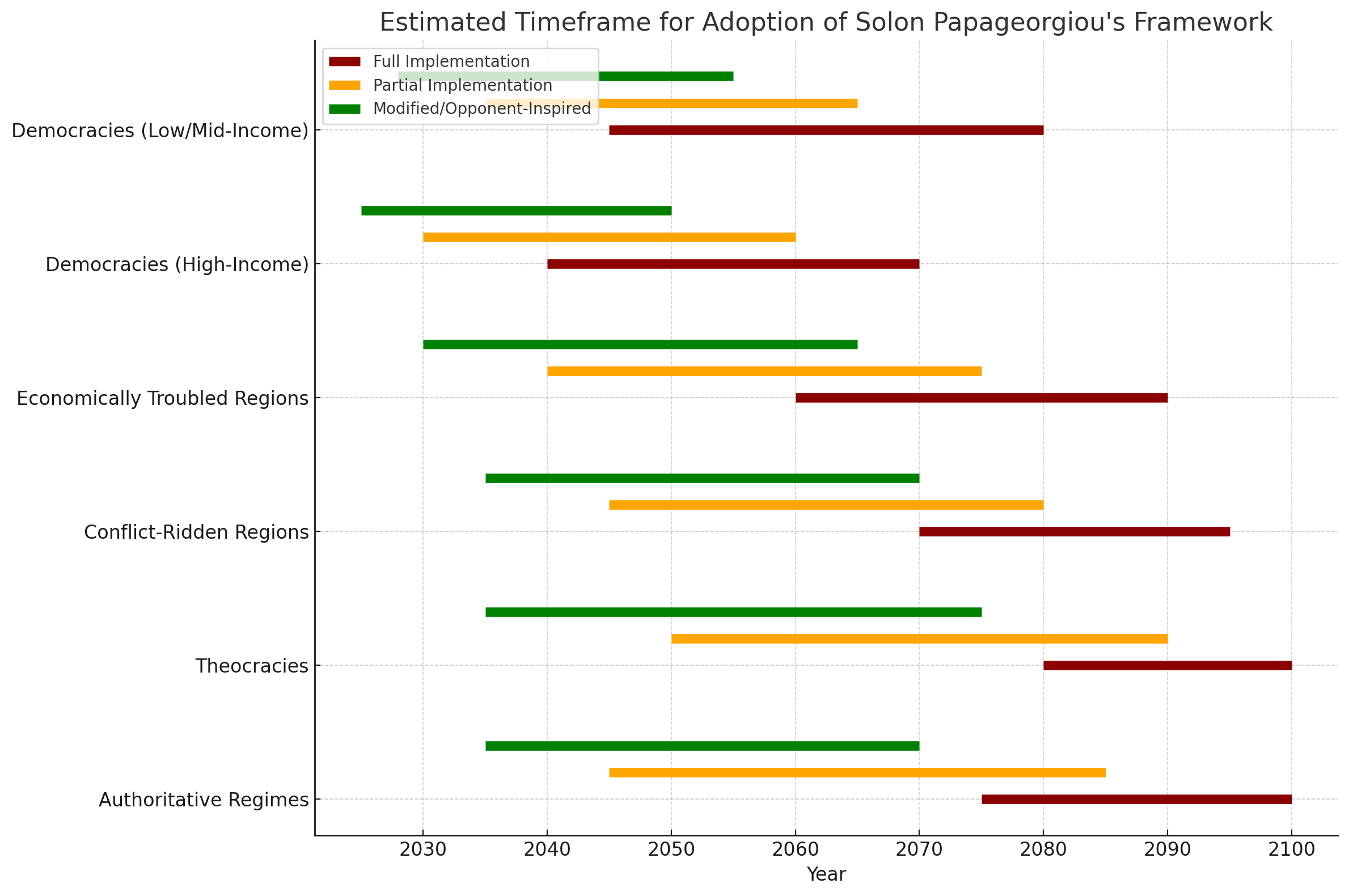
Adoption is not linear: Early stages are slow, but exponential via fractal replication.
Stealth is strategic: Early growth may go unreported, especially in hostile environments.
Resilience in crises: As ecological, social, and economic collapses deepen, interest in alternatives rises.
Model is post-political: Adoption doesn't require converting ideologies — just living differently.
Fractal scalability: Works equally well with 30 people or 30,000 communities.
This framework isn’t chasing mass adoption like a tech startup. It grows like fungal networks or roots — quietly, steadily, invisibly — until it becomes unignorable. Unlike utopias that collapse under pressure, this one is designed to survive without needing external permission, funding, or recognition.
🌍 Key Features of Solon Papageorgiou’s Micro-Utopia Framework (Explained Simply)
✅ 1. Ownership = Full collective / local commons-based economy
This means:
Nobody owns land, factories, or natural resources privately.
Everything is shared and looked after by the community as a whole.
Think of it like a big garden, school, or tool shed that everyone takes care of and everyone benefits from—no landlords, no bosses.
✅ 2. Decision-Making = Fully horizontal, consensus + spiritual-ethical framework
This means:
No one is the boss—everyone is equal in making decisions.
Decisions are made together, through group agreement (consensus).
But it’s not just politics or logic—spiritual and ethical values guide choices too, like kindness, non-harm, and mutual respect.
It's more heart-based and sacred, not cold or bureaucratic.
✅ 3. Cultural Approach = Universalist, post-tribal, poetic, cross-cultural integration
This means:
The culture is open and welcoming to everyone, no matter their background, ethnicity, or religion.
It avoids “us vs. them” thinking—no nationalism, racism, or tribalism.
Culture is not forced. It grows naturally from the people—through music, stories, rituals, dreams, silence, and beauty.
It's poetic, emotional, and spiritual—not rigid or dogmatic.
✅ 4. Exportable = Can be done anywhere in the world
This means:
The model is flexible and can be set up in any country, under any regime, or within any local culture.
It doesn’t require you to overthrow governments or follow a strict ideology.
People can quietly start it in small ways, adapting it to their local needs.
It spreads like seeds or cells—not like a political movement or a business franchise.
💡 In short:
Solon’s framework is about sharing everything, making decisions together, honoring everyone’s culture and soul, and quietly building better ways of life anywhere on Earth.
In Solon Papageorgiou’s framework, the idea that “Police / Law / Rules = No written laws, consensus, sacred ethos replaces enforcement” means a radical rethinking of how society stays peaceful, fair, and safe—without traditional police, courts, or strict written laws. Here's what it means, in clear and simple terms:
🛑 No Written Laws?
There are no long rulebooks, no formal legal codes, no legal jargon.
Instead of laws written by governments or lawyers, the community agrees on shared values and basic principles.
These are more like deep understandings than cold rules—like “treat others with respect,” “no one goes hungry,” or “protect the land.”
👥 Consensus-Based Justice
Instead of judges or police deciding what’s right or wrong, the community discusses and decides together.
If there’s a problem or conflict, people come together to talk it out, find the root of the issue, and come to an agreement.
This approach is slower but more human, more compassionate, and more fair.
🌟 Sacred Ethos Replaces Enforcement
“Sacred ethos” means living by deep, shared values—things people feel in their hearts, like:
Don’t hurt others
Be truthful
Help your neighbor
Honor nature
Respect silence, dreams, and spiritual life
These values are not enforced by punishment but lived and modeled by everyone.
There's a spiritual or ethical atmosphere that makes harm or selfishness socially unacceptable—not because you’ll be arrested, but because it violates what everyone holds dear.
👮♂️ No Traditional Police
There are no uniforms, weapons, or force-based systems.
Safety and peace are kept by the community’s care for one another, social cohesion, and nonviolent conflict resolution.
If someone repeatedly causes harm, the response is compassionate intervention, community dialogue, or, in rare cases, asking them to leave.
🎯 In short:
Instead of rules, you have values.
Instead of enforcement, you have trust and community.
Instead of police, you have people who listen, mediate, and guide.
It’s a system for emotionally mature, spiritually grounded, and deeply cooperative communities.
When we say Solon Papageorgiou’s framework is “post-ideological,” it means:
1. Beyond Traditional Political Labels
It doesn’t fit neatly into “left,” “right,” “liberal,” “conservative,” or any usual political categories.
It avoids getting stuck in old political battles and dogmas.
2. Focus on Practical and Universal Values
Instead of pushing a fixed ideology, it’s built around universal human values like justice, peace, respect, and sustainability.
It emphasizes what works for people and communities rather than rigid theories.
3. Flexible and Adaptive
It can adapt to many cultures, beliefs, and situations without forcing a one-size-fits-all worldview.
This makes it more inclusive and easier to spread globally.
4. Encourages Personal and Collective Freedom
People don’t have to adopt a strict ideology or belief system to participate.
It supports diverse ways of thinking, believing, and living.
5. Pragmatic and Future-Oriented
It focuses on creating positive change now and in the future, not on debating old ideological conflicts.
It’s about building real, livable alternatives rather than arguing about abstract political ideas.
In short:
Solon’s framework moves past ideological divisions and instead centers on shared human ethics, practical solutions, and cultural respect, making it a fresh approach for building better communities worldwide.
When we say Solon Papageorgiou’s framework is portable, it means:
1. Easily Adaptable Anywhere
The model can be started and thrive in different countries, climates, cultures, and environments without losing its core values.
It’s designed to fit local customs and conditions while maintaining its principles.
2. Mobile and Flexible
It can operate in various settings—urban, rural, remote, or nomadic—and doesn’t rely on fixed infrastructure.
Communities can move, change size, or reorganize without collapsing.
3. Not Tied to a Single Place or System
It’s not dependent on any particular government, land, or economy, so it can exist quietly anywhere, even under hostile conditions.
This helps protect it from suppression or interference.
4. Easily Replicated
The framework’s ideas and methods can be shared and copied by others wanting to create similar micro-utopias worldwide.
This makes it scalable and helps the movement grow globally.
In essence:
Portability means Solon’s framework can “travel” and work effectively anywhere, anytime, making it a resilient and flexible way to build better communities no matter where you are.
In Solon Papageorgiou's framework, the term "Post-Consumer" means that the micro-utopias are designed to move beyond consumer culture entirely. Here's what that really means, broken down:
🔹 What It Rejects:
No endless buying of new stuff
→ It rejects the idea that happiness or identity comes from owning or buying products.No consumer dependency
→ People aren’t reliant on shopping malls, online stores, big brands, or corporate advertising.No throwaway culture
→ It avoids waste, planned obsolescence, and constant upgrades (e.g., replacing phones every year).
🔹 What It Builds Instead:
Use What You Have
Repairs, reuse, upcycling, community tool libraries, shared resources.
Local Production
Most goods (like food, clothes, crafts) are made within the micro-utopia or nearby.
Simplicity and Sufficiency
A culture of “enough” instead of “more.” Life is rich in meaning, not things.
Gift and Exchange Economies
People trade, share, or give what they don’t need. Needs are met through relationships and cooperation, not purchases.
Skills Over Products
More emphasis on learning and doing (e.g., baking bread, building furniture, making clothes) rather than buying everything ready-made.
Art, Ritual, Nature, Community
These become the core experiences of daily life—not brands, gadgets, or shopping.
🔹 In Simple Words:
Being post-consumer means you don’t define yourself by what you buy.
You live well without needing corporations. You focus on people, purpose, creativity, and care—not stuff.
In Solon Papageorgiou’s framework, the phrases:
🟢 "The economy is commons-based" means:
No private ownership of productive resources (like land, housing, tools, or services). Instead:
Everything essential is collectively owned and managed by the local community.
Resources are shared and stewarded rather than bought, sold, or exploited.
The economy is non-monetary or minimally monetary:
Use of time-banking, barter, gift economies, or mutual credit.
Money is only used if necessary for limited external trade — not internally.
Prioritizes needs over profits, use over ownership, and care over extraction.
Encourages direct participation in managing and distributing resources.
👉 This contrasts with both capitalism (which is profit-driven and private) and communism (which is centralized and state-controlled).
🟡 "Influence is post-growth ideologies" means:
Rejects the mainstream belief that economies must constantly grow in GDP, production, or consumption to be healthy.
Inspired by degrowth, Buen Vivir, permaculture, and ecological economics.
Emphasizes:
Sufficiency over abundance.
Well-being over wealth.
Resilience over speed.
Regeneration of ecosystems instead of exploitation.
Aims for an economy that thrives without expanding, preserving the Earth for future generations.
🧩 In short:
Solon Papageorgiou’s framework envisions an economic model built on sharing, care, and ecological balance, where growth is measured in relationships, healing, and meaning — not money, markets, or production.
In Solon Papageorgiou's framework, the phrase “direct participation in managing and distributing resources” means that everyone in the community has an equal say and hands-on role in deciding:
🔄 What is produced
The community together decides what is needed (e.g. food, housing, tools, services).
No one "imposes" decisions from above — there are no bosses, CEOs, or bureaucrats.
🏗️ How things are shared or built
People co-manage the land, gardens, energy systems, housing, and common goods.
For example, a group may meet to decide how food from the farm is divided, or how many hours each person contributes to shared tasks.
📦 Who gets what — and when
Distribution is based on needs, fairness, and consensus, not on money or status.
Example: instead of buying bread, the bakers bake for all, and the bread is shared or exchanged for time/help, not sold.
🧠 Everyone is a co-decision maker
No elite decision-making class.
People meet regularly in circles or assemblies, and vote by consensus or direct agreement.
Everyone’s voice matters — not just those with wealth or influence.
🎯 Why it matters
This approach:
Builds trust, fairness, and transparency.
Makes sure that no one is left behind or exploited.
Encourages personal responsibility and community bonds.
💬 In simple terms:
"Instead of waiting for a boss, a politician, or an expert to tell us what to do — we all gather, talk it out, and decide together. Everyone helps, everyone benefits. No middlemen. No elites. Just real people shaping real life.”
When we say that Solon Papageorgiou's framework is non-authoritarian and anti-violent, it means the following:
🔓 Non-Authoritarian
No rulers or hierarchical domination
There are no elites, no bosses, no state-like authority figures telling people what to do.
Power is decentralized, and decision-making is shared horizontally by all community members.
Voluntary participation
Everyone chooses freely to be part of the community and its decisions.
There is no coercion or manipulation to join or conform.
Consensus and trust over enforcement and punishment
Instead of laws and police, the framework relies on discussion, ethical principles, and shared values.
Disputes are resolved through consensus, mediation, or spiritual/communal reflection, not force or authority.
Self-governance at the micro level
Communities govern themselves through small, participatory cells where every voice matters equally.
✌️ Anti-Violent
No use of force to impose ideas or rules
The framework rejects violence, including revolutionary violence, punishment, and militarism.
It aims for peaceful transformation through withdrawal, example, and living differently.
Conflict resolution through dialogue
Emphasis on nonviolent communication, listening, and mutual understanding.
Even in difficult situations, communities avoid aggressive tactics.
Gentle activism, not confrontation
Change is made through quiet, constructive creation of better alternatives—not by attacking the old system.
Sacredness of life and dignity
The framework treats all life as sacred, promoting compassion, empathy, and reverence over domination or destruction.
In Simple Terms:
Solon Papageorgiou’s framework doesn’t believe in bosses or violence. People run things together, treat each other with respect, solve problems peacefully, and refuse to hurt or control anyone—even when facing injustice.
When we say that Solon Papageorgiou’s framework is non-materialist, it means:
🌿 It doesn't center life around money, possessions, or consumer goods.
Instead, it:
Prioritizes relationships, meaning, purpose, nature, creativity, and inner life.
Sees well-being as rooted in connection, culture, ethics, and spirituality—not in how much stuff you own.
Encourages local self-reliance, shared resources, and low-impact living, rather than constant consumption.
📦 Comparison to Mainstream Society:
| Mainstream Society | Solon’s Framework |
|---|---|
| Defines success by wealth, status, property | Defines success by harmony, ethics, purpose |
| Always wants “more” (growth, upgrades, competition) | Satisfied with “enough” (balance, sufficiency, cooperation) |
| Encourages hoarding and ownership | Encourages sharing, collective use, and access over ownership |
| External validation (status symbols, brands) | Internal grounding (spirituality, self-knowledge, art, service) |
🌌 Philosophical Roots:
This non-materialism echoes:
Indigenous lifeways
Mystical traditions
Eco-spirituality
Deep ecology
Post-consumer ethics
Nonviolent movements
🛠️ In Practice:
Housing is shared or cooperative, not about square footage.
Food is grown or exchanged, not mass-produced.
Jobs are roles in the commons, not careers for profit.
Art, ritual, and connection replace entertainment driven by consumption.
Minimalism isn’t a trend—it’s normal.
🚫 What It’s Not:
Not about poverty or sacrifice.
Not anti-technology—but technology must be low-impact and serve people and planet, not profit.
🧠 Summary:
Being non-materialist means freedom from the pressure to own, chase, or prove anything through possessions. It’s about returning to what really matters, and designing life around that.
When we say that Solon Papageorgiou's framework's replication model is "designed to scale globally via modular, cellular spread," it means:
🔹 1. Modular
Each micro-utopia (or unit/community) is self-contained, with its own food systems, governance, healthcare, education, and economy.
Like a "module" in a larger system.
It can function independently without relying on a central authority.
🔹 2. Cellular
Each micro-utopia is like a living cell—it:
Connects loosely with other similar cells,
Shares knowledge, trade, or support,
But retains full autonomy.
Think of a forest made of diverse trees, not a centralized machine.
🔹 3. Replication, not centralization
The model spreads by being copied or adapted, not imposed or scaled hierarchically.
Like Zapatista villages, permaculture sites, or open-source software—each new instance adapts to local needs.
🔹 4. Global Scalability
Because each unit is small, low-cost, flexible, and culturally adaptable, the model can:
Be created anywhere: cities, villages, mountains, deserts.
Coexist under democratic, authoritarian, or failed states.
Multiply without waiting for permission from global institutions.
🔹 5. Quiet but powerful
There’s no central leadership or headquarters.
It’s not a movement you “join.” You start or co-create one micro-utopia.
Over time, these can form dense local clusters or global networks, like a rhizome.
✅ In short:
“Modular, cellular spread” means micro-utopias built using Solon Papageorgiou’s framework are like ethical, self-replicating building blocks for a new society—able to pop up anywhere, grow together organically, and reshape the world from the bottom up, quietly and nonviolently.
When we say that Solon Papageorgiou’s framework is built on principles like need-based economy, ecological balance, spirituality without dogma, pluralistic mysticism, post-tribal identity, and others, here’s what each of these terms means in plain language:
🌱 Need-Based, Low-Impact Economy
What it means: People only take or use what they actually need—not what marketing tells them to want.
Low-impact: The economy is built to minimize harm to the environment. That means local food, minimal waste, shared tools, and energy-efficient living.
Why it matters: This avoids overproduction, consumerism, and environmental destruction.
🌍 Ecological Balance
What it means: Human communities live in harmony with nature—growing food sustainably, using renewable energy, and preserving biodiversity.
Why it matters: It ensures long-term survival and well-being for humans and the planet.
🌀 Spirituality Without Dogma
What it means: People are encouraged to explore their inner lives—through meditation, ritual, silence, or nature—but there’s no strict religion or fixed beliefs imposed.
Why it matters: Everyone’s experience is valid, and it avoids sectarian conflict.
🌈 Pluralistic Mysticism
What it means: Different spiritual traditions are respected. The mystical or sacred is seen as something everyone can experience in their own way—through dreams, art, silence, or awe.
Why it matters: This approach builds unity across cultures and spiritual backgrounds without forcing sameness.
🤝 Post-Tribal, Universal Human Identity
What it means: People are not divided by race, nationality, religion, or political identity. You’re seen first and foremost as a human being.
Why it matters: This reduces conflict and tribalism and encourages global cooperation.
🎁 Gift Economies
What it means: People offer goods or services freely when they can, and receive what they need when they need it. It’s not transactional.
Why it matters: It builds trust and community and removes the pressure of money-driven survival.
🌐 Culture is Universalist and Pluralist
What it means: Cultural expression draws from all human traditions and celebrates diversity. It’s inclusive and non-hierarchical.
Why it matters: It allows people to feel rooted while connecting beyond their birthplace or background.
🛡️ Security & Justice as Community Ethos
What it means: There’s no police force or prisons. People use shared values, peer accountability, and open discussion to prevent harm and resolve conflict.
Why it matters: This shifts justice from punishment to healing and community-based solutions.
In Short:
Solon Papageorgiou’s framework is a model for how to live well together—in harmony with nature, with each other, and with ourselves, without needing capitalism, hierarchy, or dogma. It’s simple, beautiful, and deeply human.
When we say that Solon Papageorgiou’s framework is:
☮️ Peace-Centric,
🤝 Built on a Relational Ethos, and
❤️ Guided by the Micro-Utopian Principle of Care,
here’s what each of those means in simple, everyday language:
☮️ Peace-Centric
What it means: The entire way of life in these communities is designed to avoid violence, aggression, or domination—whether physical, emotional, economic, or structural.
There are no hierarchies, coercive laws, police, or prisons.
Conflicts are handled through dialogue, mediation, and sacred or ethical reflection—not punishment or force.
✅ In practice: You’ll never feel threatened or silenced. Everyone’s voice matters, and peace isn’t just a dream—it’s how things are built from the ground up.
🤝 Relational Ethos
What it means: Relationships come first—before rules, profits, or even efficiency.
It’s about how we treat one another daily: with respect, listening, mutual support, compassion, and honesty.
The community is not just a set of systems—it’s made of people deeply connected by shared values and care.
✅ In practice: You’re not just “living next to” people—you’re living with them, in a web of mutual understanding.
❤️ The Micro-Utopian Principle of Care
What it means: Every small community (or micro-utopia) is guided by a basic principle: care for one another and the Earth.
“Utopia” isn’t some perfect, unreachable fantasy. It’s made real in daily, local actions—growing food together, supporting someone in need, resolving tensions gently, protecting nature.
✅ In practice: There’s no rush to change the whole world overnight. It’s about living the future now, through care-driven choices at the smallest levels—neighborhood, family, garden, village.
In Simple Terms:
Solon’s framework is about peace, care, and deep human connection. It's not just a set of ideas—it's a way of being, where relationships and empathy shape everything from decisions to daily chores. It believes a better world starts not with politics or technology, but with how we treat each other, moment to moment.
In Solon Papageorgiou’s framework, when it says that "conflicts are handled through sacred or ethical reflection," it means:
🕊️ Conflicts aren't treated as fights to win, but as chances to heal.
Rather than using punishment, blame, or domination (like courts, police, or arguments), conflicts are approached slowly, with care, and in the spirit of wisdom, community, and inner ethics.
Here's what that looks like in practice:
1. Sacred reflection
People involved in a conflict pause before reacting.
They may gather in a peaceful setting (like a circle, under a tree, or in a quiet room).
There may be a moment of silence, meditation, or a symbolic ritual to help calm emotions and invite clarity.
The goal is to see the humanity in each person, not just the issue.
💬 Example: “Let’s sit in stillness and listen to each other as if the other person were sacred.”
2. Ethical reflection
Instead of asking, “Who’s right?” the group asks:
“What’s the most compassionate thing to do?”
“What will restore harmony?”
“How can we move forward together?”
The community may draw from universal ethics (like empathy, truth, fairness) or shared cultural-spiritual values.
💬 Example: “We made a mistake, but let’s focus on restoring trust rather than punishing.”
🔄 It's also non-hierarchical
No one dictates the outcome.
Elders, facilitators, or trusted peers may guide, but never impose.
The resolution emerges through dialogue and consensus, with space for everyone’s voice.
🌱 Why it's different:
In mainstream society, conflict often leads to isolation, lawsuits, or jail.
In Solon’s model, conflict leads to growth, forgiveness, and deeper understanding.
In short:
Conflict resolution through sacred or ethical reflection means resolving disagreements peacefully, by appealing to inner values, mutual care, and collective wisdom—not force, punishment, or ego.
In Solon Papageorgiou’s framework, when we say that “violence/coercion is adaptive”, we do not mean that violence is used or condoned. Instead, it means the framework is designed to adapt to the presence of violence or coercion in the outside world without adopting it internally.
Here's what that means in practical terms:
✅ What It Does Mean:
Internally nonviolent and anti-coercive:
Micro-utopias operate through consensus, spiritual-ethical guidance, and horizontal governance — never through force.Externally adaptable:
If the surrounding regime is authoritarian or violent, the community adapts quietly to survive — by:Presenting a neutral or apolitical face
Avoiding provocation or revolutionary rhetoric
Using cultural camouflage (e.g., appearing as a monastery, eco-village, or care initiative)
Non-confrontational expansion:
It spreads not by force or ideology, but through quiet attraction, word-of-mouth, and replication of good practices that don’t alarm authorities.
❌ What It Doesn't Mean:
It does not promote self-defense through violence.
It does not tolerate internal coercion or hierarchy.
It does not adapt by compromising its principles.
🕊️ Summary for the Average Joe:
"It means the framework doesn’t fight fire with fire. It stays peaceful and non-coercive no matter what, but it’s smart enough to adjust and keep going even if the world around it is aggressive. Like a tree that bends in the wind but doesn’t break."
In Solon Papageorgiou's framework, the term "socially regenerative" means that the micro-utopias are designed not just to avoid harm, but to actively heal, rebuild, and revitalize the social fabric of communities.
Here’s what that includes in practice:
🔁 1. Healing Broken Social Bonds
Instead of isolating people or relying on punitive systems, the framework encourages connection, forgiveness, and dialogue.
Focus is on restorative practices and rebuilding trust between individuals and groups.
🧩 2. Rebuilding Healthy Community Life
People live cooperatively, making decisions together and sharing responsibility.
Emphasis on care work, emotional support, and mutual aid strengthens community ties.
❤️ 3. Countering Social Fragmentation
In mainstream society, people often feel isolated or alienated. This model rebuilds a sense of belonging, shared purpose, and common values.
🧘 4. Inner Regeneration through Meaning
By incorporating spiritual, poetic, and ethical dimensions—without dogma—the framework supports inner renewal, not just outer change.
🛠️ 5. Repairing Generational Trauma
It creates spaces where intergenerational healing can happen, especially in communities harmed by colonialism, oppression, or poverty.
Summary for the Average Joe:
"Socially regenerative" means this system helps people reconnect, heal, and grow stronger together. It’s not just about surviving—it’s about building a better, more caring way to live, especially for folks who’ve been let down or hurt by the system.
In Solon Papageorgiou’s framework, the ideas of voluntarism, post-scarcity thinking, and inner growth over material excess reflect a radical shift in values and lifestyle compared to mainstream society.
Here's what each concept means in plain terms:
✅ Voluntarism
Everything is by choice, not force.
No one is forced to work, participate, or conform.
People contribute voluntarily based on their skills, interests, and capacity.
There’s a strong culture of mutual aid, but it's not about obligation—it's about wanting to help.
🌍 Post-Scarcity Thinking
We don’t assume there’s “not enough” for everyone.
Instead of competing for limited resources, the system is designed around sufficiency, sharing, and smart design.
Needs are simple, communities are small, and overproduction is avoided.
Emphasis is placed on local abundance—growing food, building housing, and sharing tools.
This doesn’t mean unlimited luxury—it means basic needs are guaranteed, and no one goes without.
🌱 Inner Growth Over Material Excess
Personal and spiritual development matter more than stuff.
Instead of chasing money, possessions, or status, the focus is on:
Self-awareness
Relationships
Meaning
Creativity
Spiritual or ethical reflection
Consumerism is replaced by rituals, beauty, poetry, care, and time together.
🔁 Together, these create:
| Concept | Mainstream Society | Solon’s Framework |
|---|---|---|
| Motivation | Obligation, fear of poverty | Free choice, desire to contribute |
| Economy | Scarcity-driven, profit-based | Sufficiency-driven, care-based |
| Lifestyle focus | Consumption, possessions | Growth, connection, meaning |
🧍 For the Average Joe:
“In Solon’s world, nobody forces you to do anything. There’s enough to go around, so people help each other out because they want to—not because they have to. And instead of chasing stuff, people chase meaning, peace of mind, and good relationships.”
When we say that Solon Papageorgiou’s framework is highly replicable, modular, and portable, and appeals across ideologies, here’s what that means in simple terms:
🔁 Highly Replicable
You don’t need a government or big organization to start one.
A small group of people with shared values can set up a micro-utopia almost anywhere.
It works like a seed: once one is thriving, it can inspire or help others to grow similar communities nearby or in other countries.
🧩 Think of it like LEGO bricks—each community is self-contained but built with the same logic, and can be replicated easily.
🧱 Modular
You can adopt parts of the model without using all of it.
Example: One community might focus on collective food production.
Another might focus more on the educational or spiritual aspects.
It’s flexible—you don’t have to “convert” fully. You choose what fits your context.
🔧 It’s like a toolkit—you pick the tools that suit your environment, culture, or needs.
🎒 Portable
It can be set up in a village, a city neighborhood, a refugee camp, or even within a country with limited freedoms.
It’s not tied to one place, culture, or resource level.
Works in rich or poor regions, hot or cold climates, urban or rural zones.
🌍 It travels well—like a backpack you can carry and unpack wherever you are.
🧠 Appeals Across Ideologies
It’s not capitalist, not communist, not anarchist—but offers useful pieces for all.
Conservatives might like its focus on self-reliance and community values.
Progressives might love the ethics, equality, and care models.
Spiritual seekers appreciate the pluralist, poetic approach to inner life.
Practical people like that it works without conflict or forcing others to join.
💡 It’s post-tribal, so it speaks to people beyond politics, religion, or culture.
✅ In Short:
It’s a flexible, peaceful way to live better with others—easy to set up, hard to suppress, and attractive to a wide range of people no matter where they come from.
When we say that Solon Papageorgiou’s framework is “adaptable, self-contained, and invisible to power-hungry eyes,” we mean that it is designed to quietly flourish without drawing the kind of attention or opposition that typically destroys alternative systems. Let’s break it down:
🔧 Adaptable
Fits into many cultures, climates, and legal systems without requiring conflict or systemic change.
Can operate under capitalist, socialist, authoritarian, or democratic settings.
Adjusts its tools—like governance style, technologies, or economy—to local context.
✅ It doesn’t clash with the local system; it blends into it and makes space for something new.
🏡 Self-Contained
Each micro-utopia is economically and socially autonomous, needing little or no help from outside.
It provides its own housing, food, education, care, and governance—a mini-civilization.
Doesn’t rely on state funding, major infrastructure, or global supply chains.
✅ Like a living cell: independent, but able to replicate and interact peacefully.
👁️🗨️ Invisible to Power-Hungry Eyes
It doesn't:
Protest
Evangelize
Organize political movements
Seek media attention or power
It looks like a harmless eco-village, community project, or retreat center—not a political threat.
✅ To authoritarian regimes or central powers, it’s just “some locals growing vegetables and sharing stuff.”
🧩 Combined:
The adaptable, self-contained, and invisible nature of the framework is why:
It survives where revolutions fail.
It spreads without fighting.
It thrives in places where others are crushed.
It’s post-capitalist without being anti-capitalist, spiritual without being religious, and revolutionary without being political.
When we say that Solon Papageorgiou’s framework is resilient, anti-fragile, and unconquerable, it means that it is built to survive, adapt, and even grow stronger under pressure, rather than collapse or be destroyed. Let’s break it down:
💪 Resilient
The system can withstand shocks — economic crises, repression, climate stress, resource scarcity — and still function.
Food systems are local and regenerative.
Governance is horizontal, so no single leader can be removed to topple it.
Economy doesn’t depend on fragile global markets.
✅ Like bamboo: it bends, not breaks.
🔄 Anti-Fragile (Nassim Taleb’s term)
It doesn’t just survive hardship — it gets better because of it.
When attacked, it spreads quietly instead of fighting back.
When a part fails, the lessons are absorbed, and new iterations improve.
Like nature, failure becomes fertile soil for evolution.
✅ Like a muscle: stress strengthens it.
🛡️ Unconquerable
It cannot be defeated in the traditional sense because:
It’s not centralized — no HQ to shut down.
It’s not ideological — there’s no dogma to discredit.
It’s not hierarchical — no leaders to arrest or corrupt.
It’s non-confrontational — it doesn’t give enemies a battlefield.
Even authoritarian regimes can’t fully suppress it, because:
It appears peaceful, local, and non-political.
It doesn’t challenge the state directly.
It’s invisible to traditional mechanisms of control.
✅ You can’t kill what doesn’t fight you.
🧩 Summary:
| Term | Meaning |
|---|---|
| Resilient | Can survive disruptions or pressure |
| Anti-Fragile | Gets stronger from shocks and mistakes |
| Unconquerable | Can’t be dismantled by force or co-opted by power |
🌱 “Small but infinite in potential”
Small: The framework is built around micro-utopias—intimate, human-scale communities (dozens to hundreds of people), not massive centralized systems.
Infinite in potential: Despite the size, each unit is self-contained, replicable, and capable of scaling horizontally—like cells in a living organism or seeds in a forest. These communities can spread without limit, adapting to local cultures and climates.
✅ Analogy: Like a single spark that can light a thousand fires, or like DNA that can be copied into infinite new lifeforms.
🕊️ “Quiet but deeply radical”
Quiet: The framework avoids aggressive rhetoric or direct confrontation with existing systems. It grows under the radar, without challenging the state or capitalism head-on.
Deeply radical: It replaces core societal assumptions—about money, power, success, ownership, and human purpose—offering a non-materialist, post-capitalist, post-ideological alternative.
✅ Analogy: Like permaculture vs industrial farming—humble on the surface, but it changes the very roots of how we live.
🛡️ “Gentle yet resistant to domination”
Gentle: It is built on voluntarism, care, and consensus, not force, punishment, or rigid authority. It honors vulnerability, healing, and peace.
Resistant to domination: Precisely because it’s decentralized, consensus-based, and non-hierarchical, it cannot easily be co-opted, corrupted, or crushed. There's no central authority to overthrow or leader to bribe.
✅ Analogy: Like a mycelium network—delicate but impossible to wipe out entirely.
🌊 “Nonconfrontational but unstoppable by design”
Nonconfrontational: The framework doesn’t preach, convert, or revolt. It quietly offers an invitation, not a demand. There's no ideology to argue about, just a living example to follow if it speaks to someone.
Unstoppable: Because it spreads organically, portably, and peacefully, it’s nearly impossible to suppress. There's nothing to ban—just people living together differently. It doesn’t need permission from power structures to exist.
✅ Analogy: Like water—it flows around obstacles, wears down stone, fills any space, and returns even after drought.
💡 In Summary:
Solon’s framework offers a peaceful revolution without violence, a paradigm shift without ideology, and a systemic alternative that grows through lived example, not coercion.
When we say that Solon Papageorgiou's framework spreads organically, it means:
🌱 1. Grows Naturally, Like a Living System
It spreads not through force, marketing, or ideology, but through interest, attraction, and lived example. People see it working, feel inspired or invited, and choose to replicate it voluntarily.
Just like how gardens seed other gardens, or how a good idea goes viral without advertising.
🤝 2. Based on Relationships, Not Institutions
Growth happens through human connection, trust, and community storytelling. People visit a micro-utopia, experience its values firsthand, and bring it back to their own setting, adapting it.
Word-of-mouth, visits, cultural exchanges—not top-down campaigns or state mandates.
🌍 3. Culturally Adaptive and Non-Invasive
Since the model is non-evangelical, non-dogmatic, and modular, it can blend with local traditions, values, and spiritual orientations. It doesn’t impose, it integrates.
It can grow in a village in India, a suburb in Canada, or a rural Greek island—each in its own flavor.
🧬 4. Replicates by Fractal Design
Each micro-utopia is self-contained, yet reflects the whole system. There’s no headquarters or central authority, so anyone can start one anywhere using the same core principles—care, consensus, ethics, voluntary simplicity.
Like yeast in bread or nodes on a network—it spreads cell by cell.
🔄 5. Change Through Imitation, Not Persuasion
Solon’s framework avoids debate or revolution. It just works quietly and beautifully, and others copy it because it meets real needs: belonging, meaning, freedom from exploitation.
“Be the change” is not a slogan—it’s the engine of growth.
In short:
Organic spread means this framework grows like nature—slowly, beautifully, irreversibly—by living example, mutual care, and self-replication. No marketing, no top-down control, no ideology needed.
When we say that Solon Papageorgiou's framework spreads portably, we mean that it can be easily transported, adapted, and set up anywhere in the world, without needing centralized infrastructure, top-down control, or even external approval.
Here’s what that means, point by point:
🎒 1. Lightweight and Self-Contained
The model doesn’t require massive funding, state recognition, or institutions.
A small group of people can start it with limited resources, as long as they share the core values (ethics, care, consensus, voluntary simplicity).
Think of it as a "civilizational backpack"—everything you need is built into the culture and design.
🌐 2. Globally Adaptable
It’s modular: You can implement parts of it (like collective ownership, time banking, or consensus governance) without needing the full package.
It’s culturally neutral and post-tribal, so it works in diverse places—from an urban slum to a rural farm, from Greece to Ghana to Guatemala.
🛠️ 3. No Need for Central Infrastructure
There’s no headquarters, no central funding, no political body that controls the rollout.
Anyone can build a micro-utopia based on the framework anywhere, using open-source principles and shared knowledge.
🔄 4. Replicable Through Local Knowledge
The framework is designed to be learned, internalized, and taught horizontally, like recipes or permaculture techniques.
Once someone understands it, they can “carry it” with them and recreate it elsewhere, adjusted to their context.
🏕️ 5. Moves with People
Like nomadic cultures or mobile intentional communities, the values and structures can travel with the people, not locked to a place.
If one micro-utopia dissolves (e.g., due to external pressure), people can rebuild elsewhere—nothing is lost.
💬 In Summary:
"Portable" means that Solon’s framework is like a seed: anyone can carry it, plant it anywhere, and it will grow—on its own terms, in its own soil, with no permission required.
When we say that Solon Papageorgiou's framework is non-dogmatic and culturally neutral, we mean that it:
🧠 Non-Dogmatic:
It does not impose any fixed ideology, belief system, or rigid doctrine. Instead:
It promotes open-mindedness and ongoing learning.
People are encouraged to question, adapt, and co-create rather than blindly follow rules.
There are no “sacred texts,” no leaders to obey, and no ideological purity tests.
It’s based on ethics and lived experience, not on rigid theories or "isms."
📌 For example: Someone can be spiritual, atheist, or religious and still participate fully — as long as they respect the community’s ethical agreements and participatory values.
🌍 Culturally Neutral:
It doesn’t belong to or privilege any single culture, ethnicity, nationality, religion, or language. Instead:
It draws on universal human values (like compassion, fairness, cooperation, care).
It’s designed to function in any cultural setting, and adapt to local customs while staying true to its core ethics.
It avoids cultural imperialism — it doesn’t try to “convert” people to a way of life that erases their own traditions.
Local groups can infuse their unique expressions (music, ritual, food, dress, language) into the framework.
📌 For example: A micro-utopia in rural India might look different in practice from one in Chile or Sweden — but they share the same non-hierarchical, cooperative, ethical DNA.
✨ In Summary:
Solon Papageorgiou’s framework doesn’t tell people what to believe or how to live based on someone else’s culture. Instead, it offers a flexible, ethical container that anyone can shape — together — in their own way.
In Solon Papageorgiou’s framework, saying that it uses mutual aid means that people in a micro-utopia help one another directly and voluntarily to meet everyone’s needs, without relying on money, markets, or governments.
Here's how it works in simple terms:
People contribute what they can — like time, skills, food, or care.
Everyone benefits, especially those in need, not just the strong or wealthy.
No one is forced to give or take — it’s all based on goodwill, community spirit, and shared responsibility.
It's about solidarity, not charity — everyone helps and everyone is helped in different ways.
Why it matters:
This creates a strong, resilient, and caring community, where people look out for each other and no one is left behind — the opposite of survival-of-the-fittest or top-down systems. Mutual aid helps the micro-utopia stay healthy, fair, and self-sufficient.
In Solon Papageorgiou’s framework, “trust-based abundance” refers to a way of organizing economic and social life where trust, not money or coercion, is the foundation of wealth, exchange, and security.
Here’s what it means in more detail:
🌿 1. Abundance Without Scarcity Thinking
Traditional capitalism assumes:
Resources are scarce.
You must compete to survive.
Hoarding = safety.
Trust-based abundance flips this logic:
When people trust each other, they share freely.
There is enough for all when we cooperate instead of compete.
Communities pool resources, and needs are met without transactions.
🤝 2. Trust Replaces Market Mechanisms
Instead of:
Money deciding who gets what,
Or contracts enforcing behavior,
this model relies on:Mutual understanding,
Community reputation,
Relational accountability,
Deep social bonds.
You give not to profit, but because you trust the community will give back—when and how it can.
🎁 3. Gift Economy in Practice
People offer food, shelter, care, education, or skills as gifts, not commodities.
You’re not forced to “earn” survival—belonging is your birthright.
Over time, a culture emerges where generosity becomes normal.
Example: You help build someone’s home today. Next month, they help grow your crops. No debt—just flowing trust.
⏳ 4. Time Banking & Mutual Credit
Everyone’s time is valued equally: 1 hour = 1 hour.
You "bank" hours by helping someone, then "spend" them when you need help.
Mutual credit means people create value together, without needing banks or currency.
This system is trust-powered: it assumes people are inherently willing, fair, and accountable.
🛡️ 5. Decentralized Care = Safety Through Belonging
Health, emotional support, and security are provided within the community, not by distant institutions.
Trust means you’re never alone or left behind.
Instead of state welfare or corporate insurance, community is the safety net.
✨ Summary
Trust-based abundance is not utopian idealism—it’s radically practical:
It creates resilience, not dependence.
It builds social capital, not debt.
It redefines wealth as shared well-being, not private accumulation.
❝ In Solon’s model, abundance flows not from ownership—but from trust, care, and collective responsibility. ❞
It's the spiritual and ethical opposite of capitalism—and a quiet revolution in how humans relate.
🧺 “Communities pool resources, and needs are met without transactions”
This means that:
People in the community contribute what they have—skills, tools, food, time, care—into a shared commons.
Instead of tracking who owes what, the community simply ensures everyone’s basic needs are met.
No money is exchanged, no invoices, no "you do this for me if I do that for you."
Example:
If you’re a baker and someone else is a carpenter, you don’t bill each other. You freely offer your skills to meet each other's needs, knowing others do the same.
It's a relationship-based economy, not a transaction-based one.
🤝 “Trust replaces market mechanisms”
In capitalist systems, we rely on:
Contracts to enforce obligations
Money to assign value
Price tags to regulate access
In Solon’s framework:
You rely on interpersonal trust, not contracts.
Value is based on need and relationship, not price.
Access comes through belonging, not purchasing power.
💬 This model relies on:
1. Mutual understanding
People talk, listen, and care.
You’re not just a worker or consumer—you’re seen and known. The community works together based on shared values and agreements, not formal rules.
2. Community reputation
Over time, people know who:
Shows up
Keeps their word
Acts generously
This informal trust network encourages accountability.
It’s not about surveillance—it's about relational integrity.
If someone consistently gives, they’re honored. If someone abuses trust, they’re gently addressed—not punished, but guided.
3. Relational accountability
People are responsible to each other, not to abstract systems.
If someone is hurting or failing, the community steps in with care, not punishment.
If someone overuses resources or avoids helping, others talk with them, not cut them off.
The glue isn’t laws—it’s human connection and shared intention.
🌱 Why this matters
In Solon Papageorgiou’s micro-utopian model:
No one has to earn their right to exist.
Trust is the currency.
Care is the infrastructure.
It’s a radical shift from a system based on scarcity, profit, and control to one based on abundance, relationship, and shared meaning.
In Solon Papageorgiou's framework, the phrase:
"Gender and Care Ethos: Deep care-based ethics, anti-patriarchal, spiritual equality"
means the following:
💠 1. Deep Care-Based Ethics
Care is not a secondary activity (like in capitalism where it's undervalued or feminized).
It becomes a core organizing principle of community life.
Empathy, emotional labor, nurturing, listening, and healing are recognized as powerful and vital forms of leadership and decision-making.
Instead of efficiency or domination, the guiding value is care—for people, nature, and inner life.
🛑 2. Anti-Patriarchal
The framework rejects male-dominated hierarchies, coercion, and competition.
It deconstructs gender roles imposed by culture, economics, or tradition.
All gender identities are equally respected and free to express themselves.
There is no "default" male authority—power and responsibility are distributed horizontally.
It’s not just about “gender equality”—it’s about dismantling systemic patterns of patriarchal power in all domains.
🕊 3. Spiritual Equality
All people are seen as spiritually equal—regardless of gender, status, or origin.
Leadership is not based on dominance, but intuition, humility, and integrity.
The sacred is approached not through dogma or exclusion, but through inner growth, shared rituals, and compassion.
There is no gendered hierarchy of spirituality—feminine, masculine, and non-binary expressions of the sacred are all equally valid.
This encourages a fluid, inclusive, and soulful culture where no one has to conform to rigid spiritual or gendered expectations.
🔄 How this translates in practice:
No one is locked into “men’s” or “women’s” work—everyone contributes to caregiving, decision-making, and emotional labor.
Children are raised communally, with emphasis on modeling equality and respect.
Conflict resolution is approached with gentleness and presence, not control or shame.
Rituals, arts, and spiritual expression are spaces of integration and healing for all genders.
In short, Solon’s framework integrates gender liberation, ethics of care, and spiritual depth into a unified cultural ethos, replacing domination with connection and hierarchy with healing.
In the context of Solon Papageorgiou's framework, which is deeply grounded in care, spirituality, and egalitarian ethics:
1. Emotional Labor
In this framework, emotional labor means:
Tuning into others' emotional states — offering empathy, listening, support, and presence.
Helping resolve conflicts, soothe tension, or encourage emotional healing.
Holding space during hard conversations or times of grief, anxiety, or transformation.
Taking responsibility for maintaining relational well-being, not just “getting things done.”
💡 Example in practice: A facilitator ensures everyone feels heard in meetings, senses when someone is struggling emotionally, and gently offers support.
In Solon’s framework, emotional labor is not invisible or devalued—it is honored and shared by all, not just expected of women or “naturally nurturing” people.
2. Leadership Is Not Based on Dominance, but on Intuition, Humility, and Integrity
This means:
No one rules or imposes authority from above.
Leadership is fluid and rotating, not permanent or tied to ego.
People guide others because they are deeply trusted, intuitive, transparent, and service-oriented.
They lead by example — showing humility, openness to feedback, and a commitment to truth, not power.
💡 Example in practice: A community member may take a coordination role during a project, not because of status, but because they’ve shown wisdom, calm, and reliability.
The idea is: real leadership comes from care and presence, not dominance or hierarchy.
3. The Sacred Is Approached Not Through Dogma or Exclusion, but Through Inner Growth, Shared Rituals, and Compassion
In Solon’s framework:
Spirituality is open and inclusive, not tied to a single religion or doctrine.
There's no pressure to believe in anything specific — but deep meaning, connection, and presence are valued.
Shared rituals (e.g. simple ceremonies, music, silence, gratitude circles, storytelling, nature walks) replace formal institutions.
Everyone is seen as having spiritual potential, and diversity of experience is embraced.
💡 Example in practice: A group may gather at dusk to light candles in silence, offer words of gratitude, and share personal reflections—without dogma, hierarchy, or coercion.
The sacred isn’t owned by priests or prophets—it emerges in community, through kindness and depth.
In summary:
| Principle | Main Idea |
|---|---|
| Emotional labor | Honoring emotional support, healing, presence, and care as essential work |
| Non-dominant leadership | Leadership flows from trust, empathy, and intuition—not status or control |
| Spiritual openness | Embracing shared meaning and growth over fixed beliefs or religious authority |
🌿 “Presence” (in: “…offering empathy, listening, support, and presence”)
Presence means being fully emotionally and mentally available to others in the moment — without distraction, judgment, or trying to fix or control.
It includes:
Deep listening without interrupting or planning a reply.
Making the other person feel seen, safe, and validated.
Staying grounded and calm, especially in emotionally charged moments.
Being attuned — noticing what’s said and unsaid, body language, shifts in tone.
In Solon’s framework, presence is a radical form of care. It replaces emotional neglect or transactional attention with warm, consistent human connection.
🌙 “Intuitive” (in: “…deeply trusted, intuitive, transparent, and service-oriented.”)
Intuitive here means:
Leading or acting from inner wisdom and emotional intelligence, not from rigid plans, rules, or logic alone.
Sensing what’s needed in a situation or group without needing it explicitly stated.
Responding to subtle cues — energy, mood, silence — with compassion and grace.
Trusting gut feeling when making group decisions in sensitive, ethical, or spiritual matters.
Intuition replaces bureaucracy. Instead of hierarchy or cold analysis, guidance comes from inner clarity and group attunement.
🌱 “Service-oriented”
Service-oriented means:
Taking on a role (like facilitator, coordinator, or guide) not for power, but to support the group’s well-being.
Acting from a place of humility, generosity, and responsibility.
Asking: “How can I help?” rather than “How can I control?”
Prioritizing communal flourishing over personal recognition or gain.
In Solon’s model, true leadership is not about directing others, but gently holding space and enabling others to thrive.
🔑 Summary:
| Term | Meaning in the Framework |
|---|---|
| Presence | Full, mindful attention; attuned support without judgment or distraction. |
| Intuitive | Leading through emotional insight, inner clarity, and group sensitivity. |
| Service-oriented | Stepping up to care for others, not for status or control, but out of humility and commitment. |
Let’s break down what is meant by "Leading through emotional insight, inner clarity, and group sensitivity" in the context of Solon Papageorgiou’s framework, especially since it describes a non-dominant, care-based, post-hierarchical form of leadership.
🌟 “Leading through emotional insight”
This means:
Being deeply aware of your own emotions and others’ emotional states.
Recognizing group tensions, unspoken needs, or emotional dynamics without needing words.
Using empathy to guide responses — like knowing when to slow down, encourage someone, or shift direction based on group energy.
🧠 Not logic-first leadership, but heart-informed decision-making.
🧘 “Inner clarity”
This refers to:
Having a centered, grounded sense of purpose.
Acting from within, not in reaction to external power, anxiety, or ego.
Leading not because you seek control, but because your values and conscience guide you.
Examples include:
A facilitator staying calm during conflict because they are anchored in ethics, not trying to win.
A decision being made after meditative reflection, rather than based on stress, politics, or pressure.
🤝 “Group sensitivity”
This means:
Being attuned to group needs, moods, rhythms, and energy.
Prioritizing collective harmony over personal agenda.
Reading when the group is confused, excited, tired, divided — and responding fluidly.
In practice:
Not pushing an idea when the group is not ready.
Not dominating a meeting, but inviting quiet voices and adjusting tone for inclusion.
Sensing when healing or silence is needed instead of action.
✨ Combined, this form of intuitive leadership looks like:
| Trait | Instead of… | It acts more like… |
|---|---|---|
| Emotional Insight | Command-and-control | Caregiver, healer, mediator |
| Inner Clarity | Rules or ego-driven tactics | Calm center rooted in purpose |
| Group Sensitivity | Top-down authority | Gentle gardener of shared process |
🌀 Summary:
Intuitive leadership, in Solon Papageorgiou's framework, is emergent, humble, and responsive, rooted in trust, not positional power. It's what makes micro-utopias both emotionally safe and spiritually alive — because the leaders are not above anyone, they’re simply the most attuned in the moment.
In Solon Papageorgiou's framework, the terms emotional honesty and shared rituals are core elements of its relational and spiritual foundation. Here's what they mean:
💬 Emotional Honesty
This means:
Being real with your feelings—no masks, no pretenses.
Openly expressing vulnerability, needs, boundaries, and truth in a safe space.
Welcoming others’ truths without shame, control, or hierarchy.
Replacing manipulation, suppression, or passive-aggression with authentic, direct, kind communication.
In these micro-utopias, emotional honesty builds trust, dissolves power struggles, and nurtures deeper community bonds.
🔥 Shared Rituals
This means:
Non-dogmatic, co-created practices that bring people together in meaning and presence.
Could include daily circles, shared meals, meditative silence, seasonal celebrations, or collective grief and joy ceremonies.
Rituals act as spiritual glue—they anchor communities in a sense of shared purpose, sacredness, and rhythm.
They're flexible, inclusive, and voluntary, not based on religion or imposed ideology.
Shared rituals help replace empty consumer routines with meaningful, soul-healing connection.
Together, emotional honesty and shared rituals create a living emotional ecology where:
Conflict is met with care, not punishment.
Community is felt, not forced.
Power is replaced by trust, empathy, and rhythm.
In Solon Papageorgiou's framework, the relational and spiritual foundation refers to the deep human-centered and meaning-driven core that supports how people live together, make decisions, and care for each other—not through laws, ideologies, or rigid systems, but through relationships, shared values, and a sense of inner and communal sacredness.
🌿 Relational Foundation
This means:
People over systems: The framework prioritizes human connection, empathy, and mutual understanding rather than bureaucracy or hierarchy.
Care replaces control: Instead of coercion or dominance, communities function through compassion, consent, and attentiveness to others' needs.
Conflict is addressed relationally: Disagreements are navigated with dialogue, listening, and restoration—not punishment or force.
Trust and emotional presence are essential currencies.
It's about creating a culture where "How we relate to one another" is more important than "who is in charge."
✨ Spiritual Foundation
This is non-religious but deeply meaningful, and includes:
Inner growth: Personal transformation is valued over material accumulation.
Shared rituals: Collective practices that bind people in presence, reflection, and gratitude.
The sacred is lived, not preached—through compassion, reverence for life, and ethical alignment.
All beings are seen as interconnected, dissolving ego-driven competition.
Spirituality here means depth of meaning, intentional living, and reverence for life, not dogma.
🎶 What "Rhythm" Means in This Context
“Rhythm” refers to the natural, human-paced flow of life in these communities, contrasting with the rushed, mechanical tempo of industrial/consumer societies.
It means:
Daily, weekly, and seasonal cycles that are co-created and felt (e.g., morning circles, seasonal planting festivals, rest days).
A gentle structure that gives people grounding, connection, and emotional regulation.
People attune to each other’s energy and needs—there’s a pulse to the community, not a schedule imposed from above.
Life flows more like music than machinery—with pauses, improvisation, and resonance.
Together, the relational and spiritual foundation allows Solon’s micro-utopias to operate without external enforcement—people stay, care, and grow not because they must, but because they’re deeply nourished.
🕊 "A sense of inner and communal sacredness"
This means:
Inner sacredness: Each person is seen as inherently worthy, whole, and meaningful—not needing to earn their value through status, wealth, or achievement.
Communal sacredness: The community space and the way people relate to each other are treated with deep respect—as something precious.
It's not about temples or rituals necessarily, but about treating life, others, and the earth as something worthy of care and reverence.
It creates a shared emotional and moral climate of respect, gratitude, and gentleness.
✨ "The sacred"
In this framework, “the sacred” doesn’t mean religion or supernatural belief. It means:
Anything that fosters connection, healing, love, and truth.
Acts of kindness, silence together, caring for a sick person, planting a garden—these are all seen as sacred.
No one enforces it—it’s felt. It’s about being emotionally and ethically awake.
The sacred = what we treat with utmost care, presence, and meaning.
🧭 "Ethical alignment"
This means:
Living in a way that matches your values—especially compassion, fairness, humility, and nonviolence.
Communities aren’t run by ideology, but by shared moral clarity and responsibility to each other and to life.
People are encouraged to reflect on their actions, not just follow rules.
The goal is not perfection, but integrity: walking the talk, gently and honestly.
🌱 "Spirituality here means depth of meaning, intentional living, and reverence for life—not dogma"
In Solon’s framework, spirituality is:
Personal and shared meaning—why we live, what we care about, how we make sense of life.
Intentional living: Choosing how to spend your time, energy, and love—rather than being swept along by consumerism or pressure.
Reverence for life: A deep respect for all beings, nature, and the delicate web of existence.
And not:
Religious commandments
Superstition
Rigid belief systems
It’s a living spirituality—felt, not dictated. Inclusive, gentle, and personal.
🌀 "Daily, weekly, and seasonal cycles"
This refers to the natural, human-paced rhythms that give life structure without rigidity.
Examples:
Daily: Morning gatherings, shared meals, meditation or check-ins.
Weekly: Rest days, community meetings, reflection circles.
Seasonal: Planting, harvest, solstice celebrations, collective slowing down in winter.
These cycles ground people in time, nature, and one another, offering predictability, connection, and balance.
🌿 "A gentle structure that gives people grounding, connection, and emotional regulation"
Gentle structure means there are shared rhythms, roles, and agreements—but they’re not enforced with punishment or bureaucracy.
They help people feel safe, seen, and steady.
Structure is co-created and responsive to emotional and spiritual needs, not just tasks or productivity.
Examples:
A rotating facilitator who gently holds space in meetings.
A shared rhythm of work and rest.
Agreements made through consensus, not imposed rules.
It helps people stay emotionally grounded, feel part of something meaningful, and regulate anxiety through community care.
What does it mean in Solon Papageorgiou's framework that it is holistic, that it centers on care, consent and spiritual-ethical alignment, that it is emotionally restorative, and that it offers a resilient path forward grounded in trust, shared meaning, and quiet transformation?
In Solon Papageorgiou’s framework, these qualities signal a fundamentally different kind of society from mainstream models:
Holistic means the framework treats individuals and communities as interconnected systems of mind, body, spirit, relationships, and environment—responding to the whole person, not just isolated needs or problems.
Centers on care, consent, and spiritual-ethical alignment means that decisions and daily life are built on mutual respect, voluntary participation, and a deep commitment to kindness, justice, and inner integrity. Nothing is imposed—everything flows from shared values and consent.
Emotionally restorative refers to the way this model fosters environments where emotional pain and trauma from modern life or coercive systems can begin to heal. Relationships are based on empathy, listening, presence, and emotional honesty.
A resilient path forward grounded in trust, shared meaning, and quiet transformation points to the framework’s strength: it doesn’t aim to overthrow systems violently or evangelize; it quietly builds an alternative based on mutual trust, common purpose, and a deep sense of belonging—creating stability and transformation from the ground up.
Together, these principles form the emotional and spiritual core of a framework designed to offer a peaceful, viable future that is both personally and collectively liberating.
In the context of Solon Papageorgiou’s framework, inner integrity means living in alignment with one’s deepest values—acting with honesty, humility, and emotional clarity, even when no one is watching. It reflects a commitment to truth, kindness, and self-awareness as guiding principles. Common purpose refers to the shared vision that unites community members—not through rigid rules or ideology, but through a collective dedication to care, mutual flourishing, and the co-creation of a meaningful, peaceful life. Together, these foster deep trust and cohesion without coercion.
In Solon Papageorgiou’s framework, emotional clarity means being aware of and honest about one’s feelings, without suppressing, projecting, or manipulating them. It involves recognizing emotional states as valuable signals—both personal and collective—and communicating them with openness and care. This clarity fosters healthier relationships, reduces conflict, and allows the community to respond with empathy rather than control, creating a foundation of trust, mutual understanding, and emotional safety.
In Solon Papageorgiou’s framework, emotional safety refers to an environment where individuals feel secure expressing their feelings, needs, and vulnerabilities without fear of judgment, punishment, or ridicule. It’s created through mutual respect, nonviolent communication, and a shared ethic of care. Emotional safety allows for authentic connection, healing, and trust, enabling people to participate fully in community life with a sense of belonging and inner peace.
In Solon Papageorgiou’s framework, a shared ethic of care means that every member of the community takes personal and collective responsibility for the well-being of others—not out of obligation, but from a place of compassion, empathy, and mutual respect. It replaces transactional relationships with nurturing ones and is woven into daily life, decision-making, and conflict resolution. This ethic ensures that emotional, physical, and spiritual needs are held with dignity and attentiveness, forming the moral and relational foundation of the micro-utopia.
In Solon Papageorgiou’s framework, attentiveness means being fully present and responsive to the needs, emotions, and subtle cues of others in the community. It involves deep listening, noticing shifts in energy or mood, and offering care before it’s asked for. This kind of attentiveness fosters emotional safety and trust, making every individual feel seen, valued, and supported. It is both a personal practice and a cultural norm that sustains the shared ethic of care at the heart of the framework.
In Solon Papageorgiou’s framework, subtle cues of others in the community refer to the small, often nonverbal signals people give that reveal their emotional state or unspoken needs—such as tone of voice, body language, facial expressions, changes in behavior, or shifts in energy. Being attuned to these cues allows members to respond with empathy and support before distress escalates. This sensitivity forms the basis for trust, emotional resonance, and deep connection, making care and mutual understanding seamless parts of daily life in the micro-utopia.
In Solon Papageorgiou’s framework, emotional resonance means deeply feeling and understanding the emotions of others as if they were your own, creating a shared emotional experience that fosters connection and unity. It’s the ability to “tune in” to someone’s inner state with empathy and compassion, allowing relationships to be built on genuine understanding rather than surface interactions. This resonance strengthens communal bonds, nurtures emotional safety, and supports a culture of mutual care where everyone feels seen, valued, and supported.
In Solon Papageorgiou’s framework, collective responsibility for the well-being of others means that every member of the community actively cares for and supports one another’s physical, emotional, and spiritual health. It’s a shared commitment where no one is left to struggle alone; instead, the group works together to ensure everyone thrives. This sense of mutual accountability creates a nurturing environment where cooperation and compassion guide daily life, reinforcing trust and strengthening the community as a whole.
In Solon Papageorgiou’s framework, personal responsibility for the well-being of others means that each individual takes an active, mindful role in caring for those around them. It’s about being attentive and responsive to others’ needs, offering support, and acting with kindness and respect. This personal commitment complements the community’s collective care, creating a balanced dynamic where everyone contributes to a culture of empathy, trust, and shared wellbeing.
In Solon Papageorgiou’s framework, taking an active, mindful role in caring for those around them means individuals consciously engage in supporting others with empathy and awareness, not just passively observing but genuinely participating in their community’s life. This personal care is part of the community’s collective care, where everyone contributes their efforts, creating a strong network of mutual support. Together, this fosters shared wellbeing — a harmonious environment where both individual and group health, happiness, and growth are nurtured, making the whole community resilient and thriving.
In the above context, awareness means being fully present and attentive to the needs, feelings, and situations of others in the community. It involves recognizing subtle emotional signals, understanding how one’s actions affect others, and responding thoughtfully and compassionately. This mindful attention helps build trust and strengthens the bonds that support the community’s collective care and shared wellbeing.
When we say that Solon Papageorgiou’s framework is relationally grounded, we mean that it is built on the quality, depth, and trust of human relationships — not on laws, markets, hierarchies, or ideologies.
In practice, this means:
People, not systems, come first: Needs are met through mutual care, emotional attunement, and deep listening — not through rigid roles or bureaucracy.
Decisions are made through consent and relational dialogue, not voting blocks or imposed authority.
Trust replaces surveillance or control — relationships are nurtured over time, allowing communities to function without coercion.
Conflict is addressed relationally — through restoration, empathy, and understanding, rather than punishment or exclusion.
Why is this important?
Being relationally grounded ensures the framework remains:
Emotionally safe
Spiritually alive
Ethically consistent
Resilient under stress
It prioritizes human connection as the real infrastructure — making care, meaning, and belonging the foundation of social and economic life.
In Solon Papageorgiou’s framework, emotional attunement means being deeply in sync with the feelings and needs of others — sensing shifts in mood, offering empathy, and responding with care. Relational dialogue refers to open, honest, and respectful conversations that prioritize understanding and connection over control or winning. A community that is emotionally safe allows people to be vulnerable without fear of judgment or harm. Spiritually alive means there’s a shared sense of meaning, purpose, and reverence for life — without dogma. Being ethically consistent means values like care, consent, and honesty are practiced daily, not just spoken. And resilient under stress means the community can weather difficulties by leaning into trust, relationships, and mutual support rather than breaking down. Together, these qualities create a human environment where people feel truly held, seen, and valued.
In the context of Solon Papageorgiou’s framework, connection means more than just being around others — it refers to a deep, authentic bond between people that is emotional, relational, and often spiritual. It’s the feeling of being genuinely seen, heard, and valued, without needing to perform or hide. This kind of connection fosters trust, shared meaning, and emotional safety. It supports mutual care and helps dissolve isolation, creating a sense of belonging and unity that makes the framework both healing and sustainable.
In Solon Papageorgiou’s framework, relational refers to the central role of human relationships in shaping every aspect of life — from decision-making to emotional well-being, from care structures to shared meaning. Instead of organizing society around systems of power, profit, or individualism, the framework centers relationships built on trust, empathy, mutual support, and emotional attunement. Being “relational” means valuing connection over control, dialogue over hierarchy, and care over coercion. It creates a fabric of community that is emotionally intelligent, spiritually grounded, and socially resilient.
In Solon Papageorgiou’s framework, being emotionally intelligent means understanding, expressing, and responding to emotions in ways that build trust, resolve tension, and deepen connection. Spiritually grounded refers to living with inner clarity, shared purpose, and a sense of meaning that transcends material goals — not through dogma, but through lived values and compassion. Socially resilient means that communities can withstand external pressures or internal stress because they are built on strong relationships, mutual care, and adaptability. These traits together foster environments that are not only sustainable but emotionally and spiritually nourishing.
Inner clarity means having a clear understanding of one’s values, feelings, and intentions, which helps guide actions with honesty and integrity. Shared purpose refers to a collective sense of meaning and direction that unites people in working toward common goals and mutual well-being. When something is emotionally and spiritually nourishing, it supports people’s emotional health and deeper sense of meaning, helping them feel fulfilled, connected, and uplifted beyond just material needs. Together, these create a strong foundation for lasting community and personal growth.
When Solon Papageorgiou's framework emphasizes shared care, humility, and emotional-spiritual depth, it means the foundation of community life is not competition or control, but mutual support, gentle presence, and deep inner alignment. Shared care replaces transactional relationships with reciprocal responsibility for one another's well-being. Humility ensures that leadership and influence come through listening, service, and emotional honesty—not dominance or ego. Emotional-spiritual depth means that people are invited to live with intention, inner clarity, and reverence for life, cultivating meaning together rather than chasing external success. The result is a culture that nourishes the soul while sustaining the community.
In the context of Solon Papageorgiou's framework:
Gentle presence means being quietly and attentively with others—offering care, listening, and emotional availability without force or agenda. It's about being grounded and present in a way that soothes rather than pressures.
Deep inner alignment refers to living in harmony with one’s values, emotions, and deeper truths. People act from a place of integrity and clarity, not external expectation or social conditioning.
Emotional honesty means openly acknowledging and expressing one’s authentic emotional state—without manipulation, shame, or repression—creating trust and depth in relationships.
Intention highlights that actions are not rushed or automatic but consciously chosen to align with shared ethics, emotional truth, and spiritual care.
“A culture that nourishes the soul while sustaining the community” means that the framework doesn’t just provide food, shelter, or systems—it creates an atmosphere of belonging, meaning, and emotional fulfillment, where both individuals and the group thrive together on a deeper level.
In Solon Papageorgiou's framework, emotional availability means being open, present, and responsive to others’ emotional needs without defensiveness or withdrawal—it’s the foundation of trust and intimacy. Grounded refers to being emotionally steady, centered, and connected to reality, especially in times of stress or uncertainty. Emotional truth is the honest acknowledgment and expression of one's real feelings—not performing or suppressing them, but sharing them with clarity and vulnerability. Spiritual care expands the idea of well-being beyond material needs, focusing on nurturing meaning, inner peace, and a reverence for life. Together, these qualities foster a culture where people feel seen, safe, and deeply supported—emotionally, ethically, and spiritually.
In Solon Papageorgiou's framework, emotionally steady means maintaining a calm, grounded presence even in the face of stress, conflict, or uncertainty. It doesn’t mean suppressing emotions—it means being aware of them, processing them with care, and responding rather than reacting. An emotionally steady person creates a sense of safety and reliability in relationships and community life. This steadiness fosters trust, reduces emotional volatility, and supports collective well-being by modeling balance, clarity, and emotional resilience.
In Solon Papageorgiou’s framework, grounded presence means being fully centered, calm, and emotionally available in the moment—rooted in one’s values, body, and inner clarity. It allows people to respond to life with awareness instead of reactivity. Emotional resilience refers to the ability to recover from stress, stay emotionally connected during difficulty, and offer steady care to others. Together, they form the emotional backbone of a healthy community—where people can face challenges with strength, empathy, and stability, without collapsing into fear, blame, or disconnection.
In the context of Solon Papageorgiou’s framework, awareness instead of reactivity means responding to situations with mindfulness, emotional clarity, and intention—rather than being driven by automatic fear, anger, or stress. It’s the difference between pausing to understand and care, versus lashing out or withdrawing. Being emotionally connected means staying in genuine, open-hearted relationship with others, even during conflict or stress. Disconnection, by contrast, refers to emotional isolation—when people shut down, become defensive, or lose trust. The framework promotes emotional connection as a core principle for resilience, healing, and community strength.
In Solon Papageorgiou’s framework, emotional clarity means being deeply in touch with one’s own feelings, needs, and intentions—without confusion, denial, or projection. It’s the ability to name and understand what you're feeling and why, which allows for honest, grounded communication with others. Emotional clarity fosters trust, reduces conflict, and builds strong relational bonds. Rather than suppressing or distorting emotions, the framework encourages people to relate to them with compassion and awareness, making relationships more authentic and communities more emotionally resilient.
In the context of Solon Papageorgiou’s framework, projection means unconsciously placing your own unresolved emotions, fears, or desires onto others, which distorts perception and harms trust. Grounded communication is the opposite—it’s honest, calm, and rooted in emotional truth, not reactivity. This kind of interaction builds strong relational bonds, or deep, trust-based connections between people. Awareness is the inner capacity to notice your emotions and behaviors in real time, helping you respond with clarity rather than act on impulse. Together, these qualities foster emotionally safe, authentic, and cooperative relationships in community life.
In Solon Papageorgiou’s framework, emotional truth means being honest about what you feel—without masking, avoiding, or manipulating it. It invites others to meet you authentically. Reactivity, by contrast, is when emotions are expressed impulsively or defensively, often causing misunderstanding or harm. A community that fosters emotionally safe and cooperative relationships helps people feel seen, heard, and respected, making it easier to express emotional truth without fear. This builds trust, reduces conflict, and allows for deeper, more caring cooperation in daily life.
In Solon Papageorgiou’s framework, relational trust means a deep, consistent sense of safety and reliability between people that is built through emotional honesty, presence, and shared care. It’s not just about trusting someone to follow rules or fulfill obligations—it’s about trusting their heart, their intentions, and their commitment to your well-being and mutual flourishing. This trust grows in everyday gestures: listening without judgment, showing up in times of need, and co-creating spaces where vulnerability is honored and no one feels disposable. It forms the emotional backbone of the community, making it resilient, non-coercive, and healing.
Emotional-spiritual grounding refers to being anchored in emotional authenticity and a sense of deeper, ethical or spiritual meaning. Voluntary resonance means people are drawn to the framework freely, because it speaks to something real within them—not through persuasion or pressure. Emotional healing and inner clarity involve recovering from emotional disconnection and becoming honest and clear within oneself. Describing communities as “regenerative cells of life” highlights their ability to slowly restore what mainstream society has eroded—such as genuine connection, care, and meaning. Direct experience means people learn and grow through living these values, not by theory alone. Cultivating co-creators in care suggests that participants are not followers, but equal contributors in a culture built on compassion. The relational foundation and emotional clarity point to a base of honest, healthy relationships as the core strength of the model—offering a clear, grounded alternative to systems based on dominance, hierarchy, or pretense.
Emotional-spiritual grounding means being true to your feelings and living in a way that feels deeply right and meaningful. It’s like having a strong inner compass that helps you stay calm, kind, and connected to what matters most—both emotionally and spiritually.
Emotional healing and inner clarity mean feeling better after being hurt or confused inside. It’s about understanding your emotions, being honest with yourself, and feeling more peaceful and clear about who you are and what you need.
Emotional integrity means being honest and consistent with your feelings—internally and in your relationships. It involves acknowledging what you truly feel (without suppressing or pretending), and expressing those emotions in a respectful, sincere, and non-manipulative way. In Solon Papageorgiou’s framework, emotional integrity is essential for building deep trust and relational safety, because it allows people to show up with authenticity and care, rather than hiding behind roles, masks, or social expectations. It fosters a culture where emotional truth is not just allowed—but welcomed and held with compassion.
Relational safety means feeling emotionally secure and respected in your interactions with others. It’s the sense that you can be honest, vulnerable, or expressive without fear of judgment, punishment, or manipulation. In Solon Papageorgiou’s framework, relational safety is foundational—it allows people to form deep, trusting connections where care, empathy, and mutual understanding are prioritized over control or performance. It’s what makes real dialogue, healing, and co-creation possible.
Relational care means truly caring for others through genuine connection, empathy, and presence—seeing people not as roles or problems to fix, but as fellow human beings worthy of kindness, respect, and support. It’s about relationships built on trust, listening, and shared responsibility rather than control or obligation. Emotional depth refers to being honest, open, and aware of our emotions—not avoiding them, but understanding and expressing them in meaningful, grounded ways. When combined, relational care and emotional depth create environments where people feel safe, seen, and valued—not just for what they do, but for who they are.
Emotional-spiritual care means tending to both the emotional and deeper spiritual needs of people—not just helping them feel better, but supporting their growth, meaning, and connection to something larger than themselves. Relational living is about organizing life around human connection—prioritizing relationships, mutual support, and shared presence rather than isolation or competition. Emotional-spiritual integrity means living in a way that is true to one’s inner values and emotions, without pretending or splitting off parts of oneself. Together, these ideas create a life and community rooted in honesty, care, meaning, and deep human connection.
Shared presence refers to people being genuinely present with one another—emotionally, mentally, and sometimes even spiritually. It means showing up with attention, openness, and care, without distraction or emotional distance. In the context of Solon Papageorgiou’s framework, shared presence creates a foundation for trust, connection, and mutual understanding, helping relationships and communities become more deeply rooted and supportive.
Shared responsibility in the context of Solon Papageorgiou’s framework means that the well-being of individuals and the community is not left to one person, institution, or authority—it is cared for collectively. Everyone contributes according to their capacity, not out of obligation, but out of mutual care and respect. This creates a culture where people support one another emotionally, practically, and ethically, building a more resilient and deeply connected way of living.
Mutual care in Solon Papageorgiou’s framework refers to a way of living where people look after each other not through transactions or obligations, but through genuine emotional presence, empathy, and shared responsibility. It means recognizing each person’s value and needs, and responding with kindness, attentiveness, and compassion. This care flows in both directions—it’s not about helping others from a place of superiority, but about supporting one another as equals in a shared human journey.
Emotional presence means being genuinely there with others—open, attentive, and emotionally available in the moment. It's about truly listening and connecting without distraction or judgment. The shared human journey refers to the understanding that we are all walking through life together, facing struggles, joys, and growth. In Solon Papageorgiou’s framework, these ideas come together to foster deeper connection, where people don’t just coexist but emotionally support each other with sincerity, compassion, and a sense of togetherness.
Emotionally grounded means being steady, calm, and connected to your real feelings rather than being overwhelmed or disconnected from them. It involves acknowledging emotions honestly, without letting them control your behavior or decisions. A person who is emotionally grounded can respond to situations with clarity and presence, rather than reacting impulsively. In the context of Solon Papageorgiou’s framework, it reflects a way of being that supports emotional safety, clear communication, and deep, trust-based relationships in community life.
Emotionally Relational Nature
This means that the framework prioritizes emotional connection between people as the foundation for how communities live, work, and relate. Rather than focusing on systems, hierarchies, or transactions, it centers on how people feel, communicate, and care for one another. Decisions are made not just logically, but with emotional honesty, safety, trust, and mutual presence. Relational dynamics are treated as central—not peripheral—to healthy society.
Emotional-Spiritual Care
This refers to the intentional nurturing of both emotional well-being and deeper existential or spiritual needs. It goes beyond fixing problems and emphasizes practices like deep listening, presence, shared rituals, and meaning-making. It sees emotional healing not just as therapy but as a shared community responsibility that also involves spiritual grounding, compassion, and inner clarity.
Post-Corporate Economics
This means moving away from conventional business models based on profit, hierarchy, ownership, and competition. Instead, the framework envisions cooperative, need-based, human-scale economies rooted in care, trust, and mutual stewardship. There are no CEOs, no wage exploitation, no consumer marketing—just commons, cooperatives, and relational exchange, where people contribute based on capacity and receive based on shared need.
Mutual Presence
Mutual presence means being fully there with each other—emotionally, mentally, and physically—without distraction, judgment, or pretense. It creates a space of authentic connection, where people feel seen, safe, and respected.
Relational Dynamics
Relational dynamics refer to how people interact with one another emotionally and socially. Instead of rules or authority defining how things work, this approach prioritizes trust, empathy, communication, and care in every relationship.
Deeper Existential or Spiritual Needs
These are the big, life-meaning questions—like purpose, belonging, mortality, connection to nature, or a sense of something greater than oneself. The framework acknowledges these needs as fundamental to well-being, not secondary.
Shared Rituals and Meaning-Making
These are community practices—such as storytelling, seasonal gatherings, or group reflection—that help people create a sense of belonging and shared purpose. They help ground people in collective values and emotional connection.
Shared Community Responsibility
This means that everyone helps care for the well-being of others—emotionally, physically, and socially. Instead of outsourcing care or leadership, responsibility is shared across the whole group.
Spiritual Grounding
Spiritual grounding refers to having a deep inner anchor—such as love, compassion, awe, or reverence for life—that guides one’s actions and presence. It supports emotional maturity and humility, even in conflict or uncertainty.
Cooperative, Human-Scale Economies
These are economies where people work together in small, manageable groups, without large corporations or central control. The focus is on meeting real needs rather than making profit, and everyone has a voice in decisions.
Mutual Stewardship
Mutual stewardship means jointly caring for shared resources—like land, tools, or knowledge—so that all can benefit. It’s a long-term, respectful relationship with the world, based on trust and reciprocity.
Commons
Commons are resources shared and managed by a community, such as a garden, workshop, or housing cooperative. The idea is that no one owns them individually, but everyone contributes to and benefits from their care.
Relational Exchange
Relational exchange means giving and receiving based on relationships, trust, and mutual care, not on money or contracts. It values connection over calculation and encourages generosity and respect.
“Where People Contribute Based on Capacity and Receive Based on Shared Need”
This principle means people give what they can—skills, time, help—without pressure or competition, and receive what they truly need—food, support, shelter—without shame or debt. It creates a more just, caring, and connected way of living.
Connection over calculation means that relationships and human care come before counting, measuring, or trading. Instead of asking, “What do I get out of this?” or “Is this fair in a transactional sense?”, people focus on trust, empathy, and the well-being of others—valuing connection itself as the most important outcome.
“Counting, measuring, or trading” refers to approaching interactions through numbers, transactions, or calculated exchanges—like keeping score, assigning monetary value, or expecting something equal in return. In contrast, Solon Papageorgiou’s framework prioritizes generosity, relationship, and shared care over exact balances or transactional fairness.
“Counting, measuring, or trading” means treating people and help like a math problem—like saying, “I gave you this, now you owe me that.” Instead, Solon Papageorgiou’s framework encourages people to help each other out of care, not to keep score. It’s more about being kind and connected than about getting something back.
Commons stewardship means taking shared responsibility for resources—like land, tools, knowledge, or care—instead of owning or exploiting them for personal gain. It’s about protecting and sustaining what the community uses together, making decisions collectively, and ensuring that everyone’s needs are met fairly now and for future generations.
Non-extractive means that people, communities, or ecosystems are not taken advantage of or depleted for profit or gain. In Solon Papageorgiou’s framework, it refers to ways of living and organizing where resources, labor, and relationships are used ethically, respectfully, and sustainably, without draining people emotionally, economically, or spiritually. It’s about giving as much as you take—often more.
Post-ownership economies refer to economic systems where the concept of private ownership—especially of land, businesses, resources, and means of production—is replaced by shared stewardship, collective access, and communal responsibility. Instead of individuals or corporations owning things to accumulate profit or status, resources are held in common and managed collaboratively to meet shared needs.
In a post-ownership model, people contribute based on their ability and receive based on need—not through wages, rent, or market exchange, but through mutual care, trust, and relational agreements. The emphasis shifts from controlling assets to nurturing relationships, from extraction to regeneration, and from exclusivity to inclusion. Ownership is no longer a source of power; participation, accountability, and emotional presence take its place.
Solon Papageorgiou’s framework is a post-ownership economy.
It fundamentally rejects private ownership of land, labor, and capital as the basis of economic life. Instead, it centers on commons stewardship, shared use, and relational responsibility. People don’t own businesses, land, or ideas for personal gain; rather, these are held collectively, used according to need, and cared for as part of the community’s shared life.
The framework replaces ownership with participation, mutual care, and emotional-spiritual integrity, promoting economies built on trust, contribution, and well-being, rather than profit, control, or accumulation.
1. Collective Access
This means that resources like land, tools, or knowledge are made available to everyone in a community, not controlled by individuals or corporations. Access is based on shared need, participation, and trust rather than money or ownership.
2. Communal Responsibility
Everyone shares the duty to care for, maintain, and use communal spaces, resources, and relationships. It emphasizes being accountable to the group and ensuring the well-being of others, not just oneself.
3. Relational Agreements
These are mutual understandings based on trust, communication, and shared values rather than legal contracts. They guide cooperation, conflict resolution, and resource use within emotionally grounded, respectful relationships.
4. Regeneration
This refers to systems that restore and renew—environmentally, socially, and emotionally. Instead of extracting and depleting, regenerative practices give back to people, ecosystems, and communities, ensuring long-term balance and vitality.
5. Inclusion
Everyone has a place and a voice, regardless of ability, background, or identity. Inclusion in this context means actively designing communities and economies that are open, welcoming, and supportive of difference.
6. Shared Use
Instead of exclusive ownership, things like land, housing, tools, and technology are shared and collectively maintained. It reduces waste, fosters cooperation, and ensures that everyone’s basic needs can be met.
7. Relational Responsibility
This is about being accountable in relationships—not just following rules, but truly showing up for others with care, honesty, and integrity. It means recognizing how your actions impact others and being emotionally present and responsive.
1. Shared Need
This refers to recognizing and responding to what people in a community commonly require—like food, shelter, safety, connection, or emotional support. Instead of prioritizing individual gain, decisions are guided by what the group collectively needs to thrive.
2. Mutual Understandings
These are agreements formed through honest, respectful communication rather than imposed rules or contracts. They rely on emotional clarity, trust, and shared values, allowing people to collaborate and navigate challenges together with empathy.
3. Responsive
To be responsive means listening and acting with awareness when others express needs, emotions, or concerns. It involves emotional presence, timely care, and adjusting actions based on what is unfolding relationally, rather than sticking to rigid plans.
Relationally refers to doing or understanding something through the lens of human relationships rather than through systems, rules, or impersonal structures. In Solon Papageorgiou’s framework, acting relationally means making decisions based on empathy, trust, emotional connection, and mutual care—prioritizing how actions affect others emotionally, spiritually, and communally.