













Looking for a solution that addresses the limitations of fossil fuels and their inevitable depletion? Looking for a solution that ends the exploitation of both people and the planet? Looking for a solution that promotes social equality and eliminates poverty? Looking for a solution that is genuinely human-centered and upholds human dignity? Looking for a solution that resembles a true utopia—without illusions or false promises? Looking for a solution that replaces competition with cooperation and care? Looking for a solution that prioritizes well-being over profit? Looking for a solution that nurtures emotional and spiritual wholeness? Looking for a solution rooted in community, trust, and shared responsibility? Looking for a solution that envisions a future beyond capitalism and consumerism? Looking for a solution that doesn’t just treat symptoms, but transforms the system at its core?

Then look no further than Solon Papageorgiou's micro-utopia framework!

đŸŒ± 20-Second Viral Summary: “Micro-Utopias are small (150 to 25,000 people), self-sufficient communities where people live without coercion, without hierarchy, and without markets. Everything runs on contribution, cooperation, and shared resources instead of money, mutual credits, time banking, bartering and authority. Each micro-utopia functions like a living experiment—improving mental health, rebuilding human connection, and creating a sustainable, crisis-proof way of life. When one succeeds, it inspires the next. Micro-utopias spread not by force, but by example. The system scales through federation up to 25,000 people. Afterwards, federations join a lightweight inter-federation circle, a meta-network, The Bridge League.”

Solon Papageorgiou’s framework, formerly known as the anti-psychiatry.com model of micro-utopias, is a holistic, post-capitalist alternative to mainstream society that centers on care, consent, mutual aid, and spiritual-ethical alignment. Designed to be modular, non-authoritarian, and culturally adaptable, the framework promotes decentralized living through small, self-governed communities that meet human needs without reliance on markets, states, or coercion. It is peace-centric, non-materialist, and emotionally restorative, offering a resilient path forward grounded in trust, shared meaning, and quiet transformation.

In simpler terms:

Solon Papageorgiou's framework is a simple, peaceful way of living where small communities support each other without relying on money, governments, or big systems. Instead of competing, people share, care, and make decisions together through trust, emotional honesty, and mutual respect. It’s about meeting each other’s needs through kindness, cooperation, and spiritual-ethical living—like a village where no one is left behind, and life feels more meaningful, connected, and human. It’s not a revolution—it’s just a better, gentler way forward.

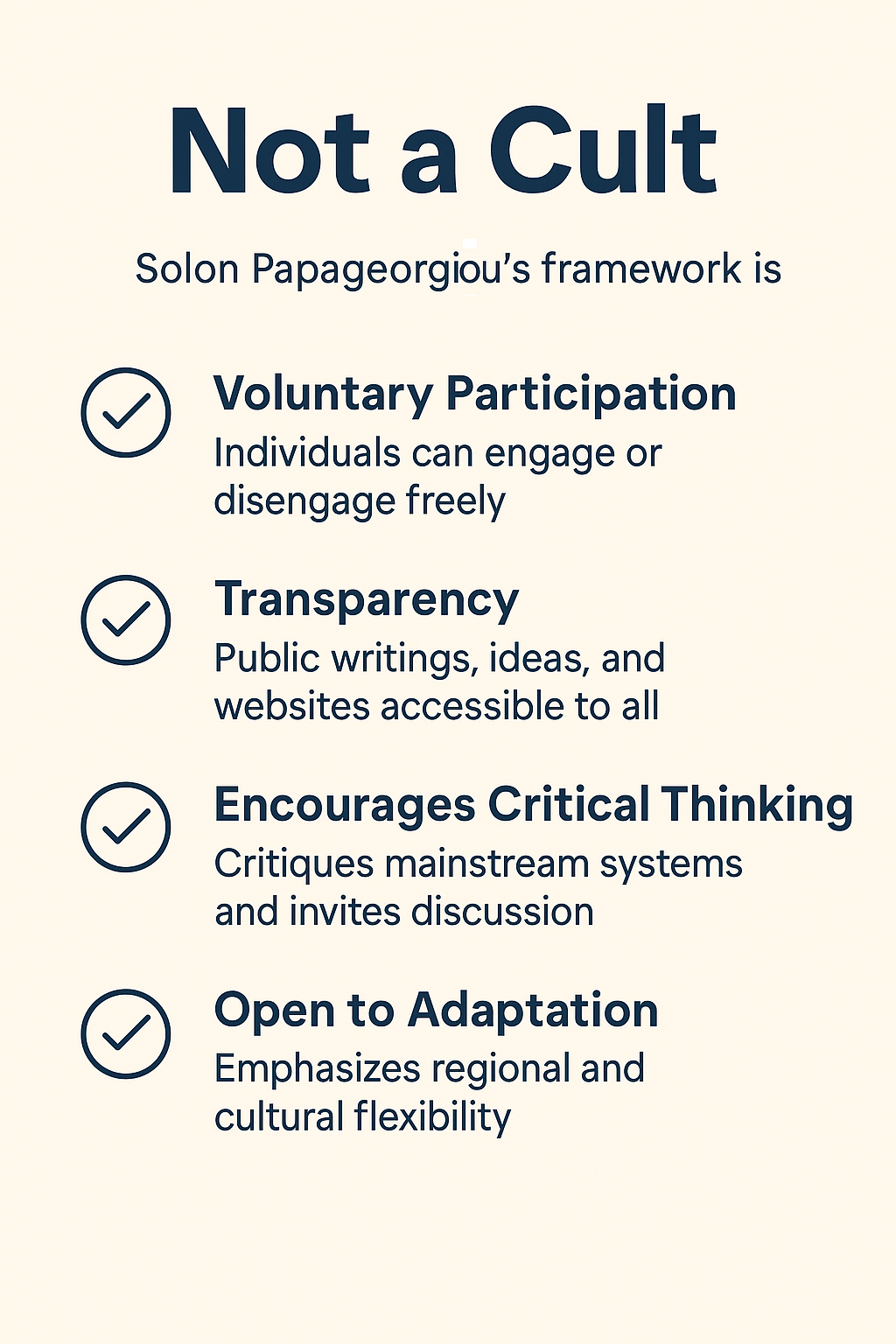
The Hunging Tree If not If not Not a Cult On Value And Failure On Value And Failure On Value And Failure On Value And Failure Secrets!

Comprehensive Step-by-Step Guide to Advancing 100% Physically and Mentally for Athletes

A comprehensive strategy that empowers nations—big and small—to build phenomenal armies, police forces, firefighting services, secret agencies, bodyguards, private investigators, and security personnel + Step-by-Step Guide to Building Phenomenal Forces Using Solon’s Vision | PDF e-book

Tailoring ITSCS + Step-by-Step Guides | PDF e-book

More Tailoring of ITSCS + Step-by-Step Guides | PDF e-book

Even More Tailoring of ITSCS + Step-by-Step Guides | PDF e-book

Click Here to Read the Simplified Summary Click Here to Read the Executive Summary Click Here to Read the Implementation Guides Click Here to Read the Implementation Guides Click Here to Read the Challenging of Psychiatry’s Foundational Assumptions Justice Bio Growth Solon's Stars Solon's Guide: Become a Superhuman ITSCS: The Ultimate System ITSCS: The Ultimate System - Part 2 Essential Herbs, Foods And Tools For Survival And Health Agriculture, Poultry Raising, Fishing, and Livestock Farming Techniques Become multilingual the easy way and in no time! How To Do Meditation: For Professionals, Civilians And All Ages! Build Your Own Home Gym: Affordable, Effective, and Convenient! Apps! Bullet-Resistant Gear, Effective Training And More At Virtually No Or Little Cost And The Implications Of Such A System Solon Under Danger Global Effects Stars-Leaders Superhumans vs Stars-Leaders Current Leaders, Exceptional Individuals & Stars Solon's List & Proofs of the Divine Solon's income and the Sharing of it Cyprus, the 14, the EU, the UN and More Resolution of the Cypriot Problem and Other Global Issues The Guide of How to Raise Superhumans and Star-Leaders Solon's leadership Are You a millionaire? Become a Billionaire! A New Flourishing Era for Psychiatrists and the Psychiatric Big Pharma! Thrive! Unleash Your Full Potential & Beyond! Free For All And Licensing Terms for the Framework The Power of Love Animals Thrive! End to Humanity's Existential Threats! Evolution for All and Everything!

Teacher/Mentor Training Manual + Learner Handbook

📘 Teacher/Mentor Training Manual (full model)
📗 Learner Handbook (full model)


📘 TEACHER / MENTOR TRAINING MANUAL

For the Micro-Utopia Education Framework

1. Purpose of This Manual

This manual prepares mentors, facilitators, and educators to deliver learning experiences within Solon Papageorgiou’s Micro-Utopia framework. It replaces the industrial teaching model with relational, project-based, community-embedded learning.

It is not a traditional pedagogy guide. It is a practice guide rooted in:

  • Decentralized learning

  • Peer-led knowledge creation

  • Holistic development (cognitive, emotional, moral, cooperative)

  • Low hierarchy, high autonomy

  • Place-based, real-world tasks

  • Intergenerational mentorship


2. Core Principles of Micro-Utopia Education

2.1 Learning Is Life-Integrated

Classrooms are replaced with:

  • Learning circles

  • Workshops and studios

  • Community farms and labs

  • Apprenticeship hubs

  • Digital collaboration spaces

Education is embedded in daily communal life, not separated from it.

2.2 Mentors Are Guides, Not Authorities

Educators:

  • Facilitate rather than dictate

  • Pose questions rather than provide conclusions

  • Empower learners to design their own learning paths

  • Help resolve disputes constructively

  • Model emotional regulation and cooperation

2.3 Self-Paced Mastery

There are no grades, standardized tests, or fixed age groups.
Learners advance when they achieve competence, not when the calendar turns.

2.4 Project-Based, Portfolio-Driven

Every learner builds a living portfolio of:

  • Projects

  • Experiments

  • Community contributions

  • Reflections

  • Skills demonstrated

  • Mentorship notes

The portfolio is the transcript.


3. Roles and Expectations of Mentors

3.1 Primary Responsibilities

  • Guide project-based learning.

  • Offer personalized coaching.

  • Provide emotional support and positive modeling.

  • Facilitate conflict resolution among learners.

  • Coordinate learning pathways with parents and community task forces.

  • Maintain transparent, non-coercive communication.

3.2 Weekly Practices

  • Run learning circles.

  • Meet learners 1-on-1 for progress check-ins.

  • Host skill workshops (3–8 hours/week).

  • Document learner growth.

  • Adjust individualized learning plans.

3.3 Non-Responsibilities

Mentors do not:

  • Grade students

  • Punish, shame, or coerce

  • Enforce standardized curricula

  • Teach to tests

  • Prioritize memorization over applied learning


4. Methodologies

4.1 The Five Modes of Learning

  1. Exploration – curiosity-led discovery

  2. Apprenticeship – hands-on skill building with an expert

  3. Cooperative Projects – team-based challenges

  4. Reflection – journaling, dialogue, self-assessment

  5. Community Contribution – using skills to improve the micro-utopia

4.2 Weekly Learning Flow

  • Mondays: Vision-setting, project planning

  • Tuesdays–Thursdays: Workshops, apprenticeships, field work

  • Fridays: Presentations, feedback circles, reflection

  • Weekends: Optional deep-dive labs, community festivals, art gatherings


5. Assessment and Growth Tracking

5.1 Portfolio System

Each learner maintains a digital and/or physical portfolio including:

  • Projects

  • Skills achieved

  • Peer feedback

  • Mentor reflections

  • Self-evaluations

5.2 Rubrics Based on Competence

Assessment categories:

  • Creativity

  • Collaboration

  • Technical skill

  • Initiative

  • Problem-solving

  • Social-emotional growth

No numerical grades—just descriptors and pathways forward.


6. Mentor Self-Development

Mentors engage in:

  • Weekly peer supervision

  • Monthly inter-mentor learning exchanges

  • Annual retreats

  • Reflective journaling practices

  • Emotional competence training

  • Facilitator skill-building


7. Conflict Resolution in Learning Settings

Mentors use:

  1. Nonviolent communication

  2. Restorative dialogues

  3. Mediation circles

  4. Solution-finding workshops

  5. Community accountability agreements

Punishment is replaced with collaborative repair.


8. Mentorship Ethics

  • Radical respect for learner autonomy

  • Zero coercion

  • Transparency in all decisions

  • Non-hierarchical interactions

  • Protection from emotional or social harm

  • Strict boundary ethics for mentors


9. Appendix: Teaching Tools

  • Project design templates

  • Portfolio rubrics

  • Conflict resolution scripts

  • Workshop formats

  • Learning circle prompts


📗 LEARNER HANDBOOK

For Students in Micro-Utopias

1. Welcome

This handbook helps learners navigate the Micro-Utopia education system—a flexible, creative, non-competitive, project-driven approach to learning.

You will:

  • Build real skills

  • Work on projects that matter

  • Contribute to your local micro-utopia

  • Learn at your own pace

  • Learn with peers of all ages

  • Be supported—not graded or judged


2. What Education Looks Like Here

2.1 No Classrooms

Instead of classrooms, you’ll learn in:

  • Workshops

  • Gardens and forests

  • Digital studios

  • Community labs

  • Maker spaces

  • Skill hubs

  • Mentor houses

2.2 No Grades

You won’t receive:

  • Grades

  • Exams

  • Rankings

  • Age-based levels

You will receive:

  • Mentor feedback

  • Peer insights

  • Growth reflections

  • Skills mastery badges

2.3 Choose Your Learning Path

Every learner designs a personal Learning Pathway:

  • Themes you want to study

  • Skills you want to master

  • Projects you want to create

  • Mentors you want to work with


3. Daily Life as a Learner

A Typical Day

  • Morning: planning circle

  • Late morning: apprenticeship or workshop

  • Afternoon: project time

  • Evening: reflection journals, community activities

Weekly Rhythm

  • Monday: orientation & planning

  • Friday: presentations & celebrations


4. How to Choose Projects

Good projects are:

  • Useful to the community

  • Interesting to you

  • Achievable in a few weeks or months

  • Connected to real problems or passions

Examples:

  • Build a solar dehydrator

  • Create a community art mural

  • Design an app for local coordination

  • Research local plant medicines

  • Run a robotics workshop for younger peers


5. Your Portfolio

Your portfolio is your learning record.

It contains:

  • Projects

  • Photos and videos

  • Sketches and notes

  • Feedback from peers

  • Reflections

  • Skills you’ve earned

You can take your portfolio anywhere—it is your educational identity.


6. Conflict & Cooperation

Conflicts happen.
Here’s how they’re handled:

  1. Calm yourself

  2. Explain how you feel

  3. Listen to the other person

  4. Work together on a solution

  5. If needed, ask a mentor for support

No punishments, no shame—just problem-solving.


7. Your Rights as a Learner

You have the right to:

  • Respect

  • Emotional safety

  • A learning pace that fits you

  • Access to mentorship

  • Projects aligned with your passions

  • A voice in community decisions


8. Your Responsibilities

You are responsible for:

  • Helping your team succeed

  • Respecting others’ boundaries

  • Caring for shared resources

  • Honoring community agreements

  • Keeping your portfolio organized

  • Participating in learning circles


9. Final Note

You are here to grow—not to compete.
To create—not to memorize.
To collaborate—not to climb hierarchies.
To become your most capable and authentic self.
Who's new

  • Barrettfig
  • KaresPaync
  • Leoia
  • RandyMoile
  • Shraunweb
  • JamesPaync
  • Brianbet
  • PatrickTar
  • JaceKaL
  • Adriankax
  • Matthewtog
  • VictorFah
  • CharlesFah
  • LanguageExplor

  • tgkoknae
  • LonnieMup
  • PamelaRor
  • AllenOpign
  • FreddieTaM
  • ZarChita
  • AlfonzoLem
  • JamesBak
  • otaletyepu
  • MitziHox
  • Gabrielcof
  • Eugenedenda
  • ChatGPTTuP Onl

  • Ellenfix
  • Shrauncik
  • JamesPreen
  • Ronaldjouck
  • RonaldDeedy
  • Danielkaf
  • Luizacoipt
  • Monica fem
  • Kirstenecora
  • Travismor
  • Annikacoirm
  • CharlesSab
  • DennisCow
  • Marievelia
  • Michaelcew
  • JulieAlame
  • Andrewwak
  • RobertLoake
  • GeraldLix
  • NathanEstab
  • Merlin AI fub

Made by Solon with -`♡®-

About This Website

Medical Safe Disclaimer

Author Of This Website